 david coombe history
SUMMARY: In Sydney in September 1852, George French Angas lithographed two views of the Victorian diggings: Forest Creek, Mount Alexander, from Adelaide Hill and Eagle-Hawk Gully, Bendigo. He then sent copies of these, together with a pencil sketch of the Commissioners Camp to his London publisher, Hogarth. He promoted them as being on the spot sketches by himself.
This article shows the weight of evidence is against Angas' presence at the Victorian diggings and that, instead, he again used Gill's pictures for a publication. This further cements the role of Gill as a ghost artist for Angas.
Article type: NARRATIVE, ANALYSIS & CATALOGUE
In this article ...
NOTE: Emphases (bold) in newspaper quotations are mine.
George French Angas, in a letter to Hogarth, his London publisher, claimed to have been sketching at the Victorian diggings at the same place and time as S. T. Gill. Although this is not how Angas phrased it, he illustrated the same places as Gill – Forest Creek (Mount Alexander) and Bendigo – and was there at the same time, as can be inferred from a pencil sketch captioned June (or July) 1852. In the letter, Angas claimed he shipped from Sydney to Melbourne and back and walked 250 miles (presumably from Melbourne to the diggings and back).
One sketch places Angas on the diggings in June (or July) 1852. Angas was back in Sydney by mid-August 1852, illustrating sheet music for "Chusan Waltz". Then in late September the focus was on his Victorian diggings lithographs, judging by notices in the Sydney Morning Herald. (References are given below.) There was insufficient time between these for a goldfields sketching trip.
One problem with Angas's story is the lack of any corroborating evidence for his visit to the Victoria diggings, which he ought to have made around June/July 1852. Tellingly, in June and July 1852, fellow South Australian, Bryce Ross, drew attention to Gill's presence at the Forest Creek (Mount Alexander) and Bendigo diggings. It's hard to imagine Bryce Ross not mentioning an extraordinary coincidence of both Gill and Angas being on his patch.
A second problem is the poor return for his purported effort. In terms of publication, the outcome of Angas's claimed trip was just two lithographs. As for original works, there are two pencil sketches, one of which was the basis for one of these lithographs.
The balance of evidence is in fact that Angas wasn't there at all. He did sail from Sydney to Melbourne, but, I will argue, not to walk to the diggings, but for private purposes. It was there he picked up newly published lithographs by Gill and another artist, Tulloch, and possibly a couple of unpublished sketches by Gill.
But we start with Angas's claim.
On 25 September 1852 Sydney publishers Woolcott and Clarke gave notice of impending publication of Angas's two lithographs of the Victoria diggings:
FINE ARTS. Early in the ensuing week will be published, PRICE ONE GUINEA, TWO highly finished Lithographic Views, printed in colours, of THE EAGLE HAWK GULLY, BENDIGO, and MOUNT ALEXANDER FROM ADELAIDE HILL. The above were drawn from nature and on stone, by Mr. GEORGE FRENCH ANGAS ...
WOOLCOTT AND CLARKE, Music Warehouse and Fine Arts' Repository.1
The pair were advertised as being by Angas in life and on the lithograph stone.
Then on 11 October Angas wrote from Sydney to his London publisher Hogarth (underlines are Angas', bolds are mine):
I have made a pilgrimage to the far famed Gold Diggings of Mount Alexander & Bendigo in Victoria, & now send you two exact water color sketches taken on the spot by myself – one of Mt. Alexander diggings from Adelaide hill, Forest Creek – the other of the celebrated Eagle-Hawk Gully at Bendigo, which has turned out more gold than any other gully in the world. Every tent, & store with its flag, is exactly as it stood when I was on the ground, & all the figures are sketched from life, the coloring &c is true, but more distance may be observed in the lithographing – I am sure these views will be extremely valuable in England & I lose no time in sending them to you to be lithographed – I have lithographed them here for Colonial Sale, but we can only print 3 or 400 here from one stone on account of the warm climate –
I will dispose of these drawings & the entire copyright of them to you if you will remit me £50, as I am sure they will command an enormous sale in Great Britain now that the gold excitement is so great, especially when it is known they are the only views taken of these two famed diggings, the richest in the world – If you think it better for me you can divide the profits equally, but I really think I ought to be well paid for them as they are of such extreme interest and I had to undergo innumerable hardships & great expense to obtain them, beside a journey of 250 miles on foot, & sea voyages to and from Sydney ...
P.S. I have enclosed a third view of the Commissioners Camps at head Quarters of the Melbourne Diggings at Barker's creek – which I took on the spot during my visit to the diggings. This has never been copied nor even seen out of my portfolio. I had not time to make a colour sketch of it, I will however so mark directions on it, that it can easily be understood without & will form a most interesting companion to the other two – this of course will be included in the Copyright with the 2 of Mt Alexander & Bendigo.
Angas' third view is oddly described, especially the reference to "Melbourne Diggings". As to the Commissioners Camp headquarters at Barkers Creek, this refers to the gold commissioner's headquarters for the Forest Creek, Mount Alexander diggings, situated near the junction of Barkers and Forest Creeks, at what would later be known as Castlemaine.
Angas was sending three items to Hogarth in London – "water color sketches" of Forest Creek (from Adelaide Hill) and Eagle-Hawk Gully and an uncoloured annotated view of Commissioners Camp. This equates to the entire known output by Angas from the Victorian diggings.
Given at his time of writing he had just lithographed the first two in Sydney it would've made sense for him to send hand-coloured lithographs, rather than original watercolour paintings. The third picture for Hogarth corresponds with a pencil sketch in NLA's Jose Calvo Collection (from the Angas family). The three pictures are (with links out):
One of two Angas lithographs of the Victorian diggings. J. Allan, Lith., Sydney. Published by Woolcott & Clarke, 2 October 1852.
Note in particular the diggers in the foreground: the cradling single-handedly without a partner, the man smoking beside him and the one with long-handled pot and hand in his pocket.
One of two Angas lithographs of the Victorian diggings. J. Allan, Lith., Sydney. Published by Woolcott & Clarke, 2 October 1852.
The "third view" described by Angas corresponds with a known pencil sketch (NLA nla.obj-134535389). With its marked directions for colours, and so it could "easily be understood without", i.e., in England, this is either the very same artwork as accompanied the Hogarth letter, or another copy of the same. The original title has been overwritten and the importance of this is analysed further below. Significantly it is dated July 1852 in the inscription – seemingly written over June 1852 – implying Angas presence on the goldfields then.
The reference in the letter to Melbourne Diggings is (oddly) generic and doesn't refer to a particular gold field, but was a term occasionally used in other colonies as an alternative to "the Victorian diggings". Angas's scenes are from two gold fields: Forest Creek (Mount Alexander) and Bendigo.
Angas's claim his two watercolours were "the only views taken of these two famed diggings" is hard to reconcile with his likely knowledge, at his time of writing, of Gill's Sketches of the Victoria Gold Diggings and Diggers as they are, Part 1 published on 17 August. At that time Gill could have fairly made that claim himself concerning the Bendigo diggings.
Alan McCulloch (Artists of the Australian gold rush, 1977, 79) in referring to the three views, expressed his own doubt: "whether Angas ever visited these Victorian centres or merely copied the work of some other artist such as Tulloch is not known. In any case Angas' work conveys nothing of the spirit of Mount Alexander."
Aside from Angas's own claims in the advertisements and the letter, there is no corroborating evidence for Angas being at the Victorian diggings. But absence of evidence is not evidence of absence.
However, on the other hand, there is evidence to support another explanation for his Victorian diggings material.
It's more likely that Angas didn't visit the Victorian diggings, but instead sourced his three views from S. T. Gill (and perhaps secondarily, D. Tulloch). There is evidence Angas sailed to Melbourne at the time of the other artists' works and could have brought works back to Sydney from which to publish his own lithographs.
We'll start with the evidence of Angas's own timeline before moving on to evidence from the images themselves.
Angas's timeline reveals a previously untold and unexpected story. First we must backtrack seven years.
Pivotal to this story is Charles Lord for whom Angas had great affection. The timeline depends on following the movements of both Angas and Lord. The relationship with "Charlie" was oftentimes mentioned by W A Cawthorne in his diaries in 1844 and 1845. Also in 1845 Gill portrayed Angas and Charlie together at the Agricultural and Horticultural Exhibition; see: Cawthorne and Gill | February, March 1845. The relationship is also canvassed in Jones (2021).
What did Angas do after his return to Adelaide? How and when did he return home to Sydney? This is where the records are elusive. He may well have gone overland to Mount Gambier and Portland before shipping, as he had done in March-April 1851.10 Indeed he may have continued on from either place to the Mount Alexander diggings. But did he?
The first reported notice of Angas's artwork in 1852 is in Sydney in August 1852 when he illustrated sheet music for "The Chusan Waltz".
This places Angas in Sydney in early August sketching the newly arrived steamer Chusan and then transferring it to lithograph stone. It was "in the press" by 9 August.
There is an evidence gap between Angas in Adelaide in December 1851 and in Sydney in August 1852. The Commissioners Camp sketch implied Angas's presence on the Victorian gold dggings around June/July 1852. But if that was the case, why was illustrating sheet music his priority in August? His far more exciting Victorian diggings material was only prioritised around the early weeks of September! What could account for this?
This is where evidence of a shipping movement imposes itself:
Angas arrived in Melbourne the week following publication of Gill's 24 Sketches of the Victoria Diggings, and Diggers as they are, Part 1 (17 August) and Ham's Five Views of the Gold Fields of Mount Alexander and Ballarat sketched by David Tulloch (21 August). Did these publications come as a surprise to Angas? There was an opportunity here for Angas to quickly return to Sydney with new material at hand – 29 lithographs of the Victorian diggings. Might he also obtained two pencil sketches from Gill?
Melbourne to Sydney was about four days by steamer or a week by sail.15 (No specific return is identified, but Angas may have been in steerage and therefore unnamed in the newspapers.) This would have left plenty of time to prepare two lithographs with Angas's Sydney publisher Woolcott and Clarke.
Back in Sydney:
This timeline shows how plausible it was for Angas to bring back material from Melbourne to publish in Sydney and transmit to London. It also explains the paucity of original material by Angas from the Victorian diggings.
The lithographs themselves were of colonial artistic significance, the notice of publication commenting, "The connoiseur would be interested to know that these views have been printed in treble tinted lithography, the first attempt in the colony to print in colours, and the experiment has been wonderfully successful."17 Extant copies show the tints (black, pale blue and yellow ochre?) supplemented by small elements of hand-colouring in red, blue, yellow and brown.
The counter-argument to the proposed timeline would have Angas in 1852:
One might expect there to be more in the diary of French Angas's brother John, and I consulted it. But other than John's need to attend court for Lord's matter, the diary is largely silent on both Charles Lord and George French. And no mention of George going to the Victorian diggings.
One other thing struck me about the diary (see References below) – the writing is very neat and there are no crossings out. This raises the possibility this may not be the primary document.
There are two pencil sketches of Angas family provenance in NLA's Jose Calvo Collection. They are, with links to List of Works below:
The original title of Commissioners Camp has been overwritten and seemingly the date has been changed from June to July 1852. It would seem odd for Angas to change his own title and date.
If the above copy of Commissioners Camp is the one Angas sent to Hogarth in London, we would need to explain how it came to the Angas-Calvo collection. If Angas retrieved it later, perhaps in England, how do we explain the uncoloured annotated Forest Creek from Adelaide Hill – also in the collection – which was not sent to Hogarth? Possibly these particular pencil sketches actually remained in Angas's own hands and he sent a copy of Commissioners Camp to London. This suggests both pencil sketches were Angas's own copies.
I have examined both sketches.
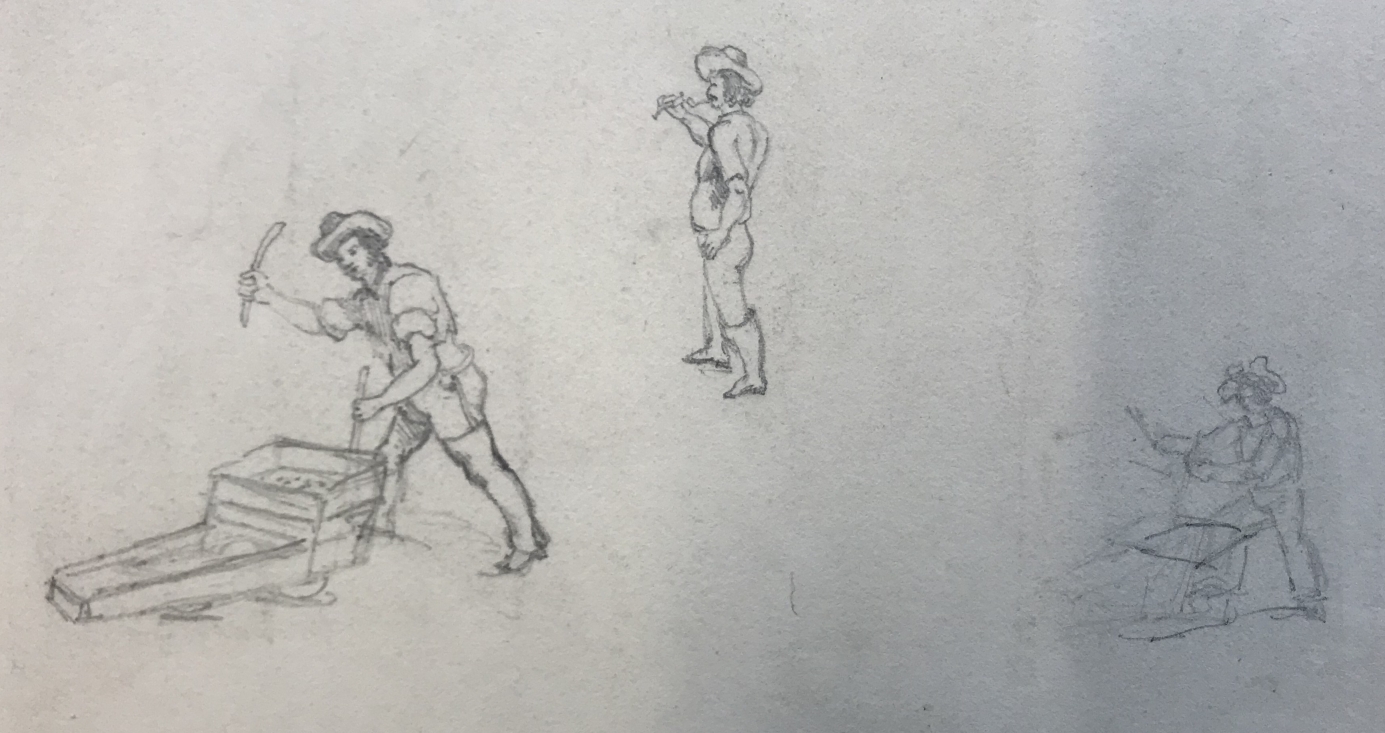
(Author's photograph, left.) On the back of Commissioners Camp are the two lazy diggers of the Forest Creek, Mount Alexander, from Adelaide Hill lithograph: the lone cradler and the smoker. We can conclude both pencil sketches were on Angas's drawing table at the same time in September 1852. Note, Angas' gold cradle has the handle on the back.
Here again is Angas's use of staffage in preparing, in this case, the Sydney lithographs. Angas's lithograph was created by adding staffage to the base landscape.
We now turn to the evidence of the pictures themselves.
We'll start with the view of Forest Creek from Adelaide Hill. The three images for this view are (with links to List of Works below):
The pencil sketch is a detailed landscape and is without many foreground characters and objects. It is of Angas family provenance, being in NLA's Jose Calvo Collection.
It's clear Angas's lithograph is based on this pencil sketch. Other than detailed characters in the foreground, these images are almost identical. Note, for example, the background hills and the detail of washing on the line. In the lithograph, the man cradling (foreground right) is atypical of portrayals elsewhere in that he is working the cradle by himself. His mate in the striped shirt, with the long handled water dipper, stands lazily with his hand in his pocket! And there is no nearby water source! A second lazy digger stands smoking a pipe. It's hard to explain Angas's lack of realism, as he had previously lithographed the Ophir diggings of New South Wales with realistically operated cradles.
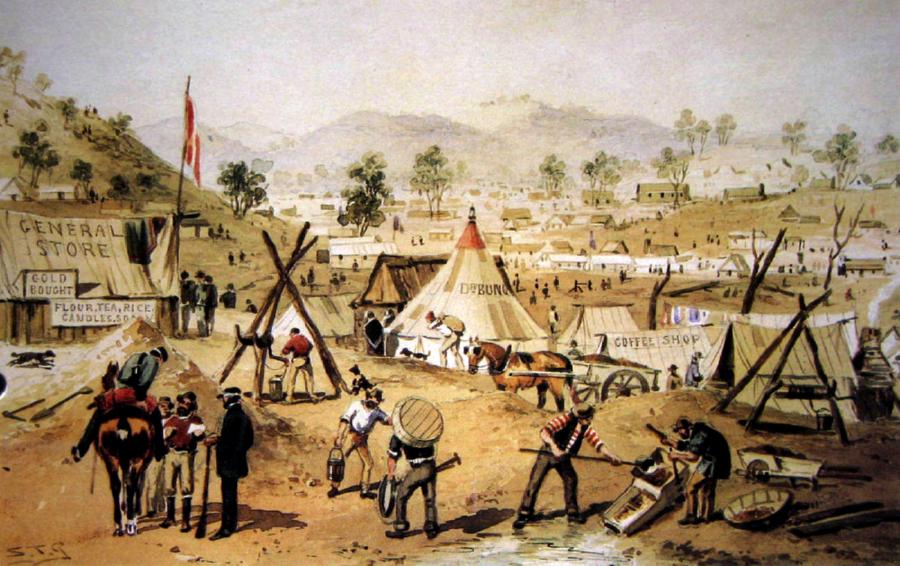
It has been assumed that the sketch is also by Angas. But there is a spanner in the works; two decades later Gill produced his own watercolour of this exact same view. Gill added his own staffage and in the process he "corrected" Angas's lazy diggers. (Gill's cradling team is in the same position as Angas's.) Although Gill's foreground characters are different, every other detail is the same as the pencil sketch, even the hill profile and washing line.
It's clear these images share a common source. Because Gill's watercolour is two decades years after Angas's lithograph one must consider the possibility that Gill copied Angas. But I think it's most likely that this pencil sketch is by Gill (or is a tracing of a Gill sketch by Angas).
The situation of Forest Creek, Mount Alexander, from Adelaide Hill is precisely analogous to Gill's Klemzig sketch used by Angas five years earlier; see Klemzig, Angas, a German Hay Wagon and Chickens.
We'll now consider the view of Eagle Hawk Gully.
I was struck by the rinbarked tree (at right of picture) in Angas's Eagle-Hawk Gully, Bendigo.
Eagle-Hawk Gully, Bendigo | National Library of Australia NK6288/A
One of two Angas lithographs of the Victorian diggings. J. Allan, Lith., Sydney. Published by Woolcott & Clarke, 2 October 1852.
Ringbarked tree at right.
And then I noticed it is similar in composition to one of Ham's Five Views of the Gold Fields ... from Drawings taken on the spot by D. Tulloch, published in Melbourne in August 1852. (Ringbarked trees are generally uncommon in contemporary images, but are used by both Tulloch and Gill.)
One of "Ham's Five Views of the Gold Fields of Mount Alexander and Ballarat, engraved and published by Thomas Ham, Collins-street, Melbourne, from Drawings taken on the spot by D. Tulloch, expressly for this Publication."
Ringbarked tree at right. Three of Tulloch's views include ringbarked trees.
These two gold fields are separate in time and space. Tulloch went to the diggings in December 1851 and the larger Bendigo rush was around May 1852.18 But it seems possible Angas has taken Tulloch's image and repurposed it as another location, perhaps using Gill's Bendigo lithographs for some quality assurance.
We now consider illustrations of the Commissioners Camp, Forest Creek. The images for this view are (with links to List of Works below):
The landscape view wasn't ever published.
Portion Commissioners Camp has the appearance of a field sketch by Gill and would have been among several he made around June 1852 to later illustrate the same subject: Diggings and Diggers 1852 - Part 2 | Diggers licensing, Forrest Creek. This is complete as an artistic work, but being titled as a "portion" of the view, Gill may have also had in mind making a bigger picture of Commissioners Camp, Forest Creek, such as NLA R6540.
I think the most likely explanation for the two pencil landscape sketches are that they either by Gill or are copies of Gill's sketches taken by Angas in Melbourne in late August 1852. It seems likely Gill allowed Angas to use this material for Sydney publication. That Gill intended to publish in "Melbourne or elsewhere" showed his openess regarding publication. Perhaps Gill allowed Angas to publish this limited material in Sydney, while he would take on the Victorian market with his extensive output.
Not much can be said about Eagle Hawk Gully, but this view may have been imagined by Angas based on a Tulloch lithograph.
As it turned out, Angas's three views weren't published by Hogarth in London. News of the Melbourne publications would have reached England at the same time as Angas's letter and it was not long before Gill's Part 1 was itself published in London. One wonders if Hogarth caught out Angas in a deception about being first to market.
A perhaps obscure clue to authorship is the characteristic portrayal of gold cradles.
 New South Wales gold prospecting | Mitchell Library, State Library of New South Wales SV/340
This watercolour is by Angas of the New South Wales diggings in 1851. Note the gold cradle has the handle on the back, as Angas always pictures it, whereas Gill pictures the handle on the side. (To compare, search this page for mentions of "handle".)
Angas consistently shows a back handle in his 1851 New South Wales lithograph series Six views of the Gold Field of Ophir | NGA 2005.516.1-6.
It practically impossible to prove a negative such as Angas never having visited the Victorian diggings to get his pictures. However there is good weight of evidence supporting the alternative narrative of him sailing to Melbourne with Charles Lord and arriving the week after the lithograph publication of works by Gill and Tulloch. And if indeed Angas had been, as he claimed, the first to illustrate these Victorian diggings, he would have gone to print much earlier and not fiddled around illustrating sheet music (in August and September 1852). The sheet music evidence also supports the alternative narrative of him returning to Sydney with diggings material from Melbourne and in particular from Gill.
The two Angas-Calvo pencil sketches are on the same paper as Angas's sketch of Sydney Harbour in September 1852, so he may well have drawn them himself, even if as a copy. And Angas transferred two images to stone in Sydney. But it seems he wasn't actually there at the Victorian diggings. He wasn't "on the spot" – what mattered for authenticity.
It's not that Angas couldn't have adequately sketched the Victorian diggings himself, it's just that it was much easier for him to get Gill's sketches – as he had previously – to generate his own publications. Angas has done the same with Gill for his South Australia Illustrated in 1844-1846. (See: George French Angas in London and S.T. Gill.) And Angas approach of adding staffage to a Gill diggings landscape is precisely analogous to his Klemzig lithograph.
Altogether, these examples point to a commercial relationship between Angas and Gill, albeit one to be kept secret; Gill as ghost artist.
It's interesting that Angas offered Hogarth the English rights to the three views for £50. What was his commercial relationship with Gill? Did he pay Gill or promise to pay him for the Sydney publication, and did he tell him about his Hogarth intention? These are questions that may never be answered.
If there had been a territorial agreement between Gill and Angas, then Angas seems to have broken it in November 1852 with sale of his prints in Melbourne.
McCulloch in 1977 was right to suspect Angas's work was derivative and that he hadn't been to the Victorian diggings. I agree.
Angas family - letters, 1836-1877 (digitised and transcribed); SLNSW Aa 11. <https://collection.sl.nsw.gov.au/record/nX6Oe4QY>. (See also Tregenza p.22.)
Scroll down to see the pictures along with detailed notes or click a link to jump to a specific work from the list.
Portion Commissioners Camp F Creek con... P Officers. | State Library Victoria H4589
Artist: Gill, S.T. | Date: 1852-06/1852-07 | 11.1(H) x 18(W) cm
Catalogue page: S.T. Gill at the Victorian Diggings, 1852
The Gold Commissioners Camp at Forest Creek showing the many tents under the trees. In the foreground a policeman (in uniform with sword) stands in conversation with an non-uniformed man, behind whom are three men with guns (probably licence inspectors).
This appears to be a field sketch with artist notes. To decipher the inscriptions I downloaded a high resolution image and enhanced it. Inscriptions: Portion Commissioners Camp F[orest] Creek ... [con?] ... P. Officers ... Camp Creek [Diggers?] ... Tall Forest Trees ... 12 tents in order ... Post Office ... A [Co..?].
SLV attributes the sketch to Gill and this is likely. Although this is an entire artistic scene, being titled as a "portion" of the view, Gill may have also had in mind making a bigger picture of Commissioners Camp, Forest Creek, such as NLA R6540 and the later (1873~) watercolour.
A Melbourne Herald desciption was quoted in October 1852: "opposite the Post office tents, looking from them up the gently rising ground from the creek, will be observed in a strait row, the twelve tents belonging to the various leading Government, civil, and military officers, immediately in connexion with the Chief Commissioner of Castlemaine; behind this row of officers' tents, come the subordinate officers' tents and various and numerous others of various shapes belonging to the police establishment, pensioners, etc.; and above and behind them again, may be seen sundry rough but snug looking bark or slab huts; among which are ensconced the wives and families, etc., of many of the men belonging to the camp below." Geelong Advertiser and Intelligencer, 14 October 1852: 4 <http://nla.gov.au/nla.news-article91930034>
Map | S. T. Gill - Victorian Diggings
684 13/04/2026 10:55:36 AM
The Commissioners camp, at junction of Barkers & Forest Creeks, Mt. Alexander diggings, July 1852 | National Library of Australia PIC SolanderBoxA16 R6540
Artist: Gill, S.T. (attr.) | Date: 1852-06~/1852-09~ | 25(H) x 35.3(W) cm
Catalogue page: George French Angas - Victorian Diggings, 1852
A broad landscape of the Forest Creek diggings featuring the Gold Commissioner's camp (left middleground).. Gill's field sketch "Portion Commissioners Camp F[orest] Creek" (SLV SLV H4589) covers the tented part of the camp to the right of the buildings.
Annotations include: "The Miners Store"; "wooden houses of Commissioners"; "military tents"; "suppy figures & some on horseback, mounted police &c"; "people washing pans & cradling on edge of creek"; "blue smoke"; "hazy"; "union jack"; "colour flags"; "butchers"; "holes & heaps of red & yellow earth"; "bridge"; "bark hut"; "grass"; "running stream" and colour instructions. (No cradle is drawn.)
The original title (l.l.) appears to have been "Commissioner [Camp?] / [Barkers &?] Forest Creek / June 1852". This has been overwritten to "The Commissioners camp, at junction of Barkers & Forest Creeks, Mt. Alexander diggings, July 1852". A later incorrectly dated inscription "George French Angas 1842" has also been added (l.c), but presumably not by the artist. Provenance: the (Angas family) Jose Calvo Collection.
Angas sent a sketch matching this description to London publisher Hogarth with a letter dated 11 October 1852 (Tregenza 22). With its marked directions for colours, and so it could "easily be understood without", i.e., in England, this is very likely the same view as the Hogarth letter.
The reverse has Angas's staffage for the lithograph "Forest Creek, Mount Alexander, from Adelaide Hill", namely: the digger cradling (rough and final versions) and the digger smoking.
The detail has the feel of an artist "on the spot", observing and capturing the landscape in detail. It may also be a composition from field sketches such as "Portion Commissioners Camp F[orest] Creek" (SLV H4589).
I think this June image is less likely to be by Angas and more likely to be by Gill (or maybe even by Gilfillan who joined Customs in June).
Map | S. T. Gill - Victorian Diggings
755
Forest Creek, Mount Alexander, from Adelaide Hill | National Library of Australia PIC SolanderBoxA16 R6541
Artist: Gill, S.T. (attr.) | Date: 1852-09~ | 25(H) x 35.2(W) cm
Catalogue page: George French Angas - Victorian Diggings, 1852
Pencil sketch for lithograph of the same name. In the pencil sketch (NLA R6541) and lithograph (NLA NK6288/B), the built structures and landscape are the same but the Angas lithograph adds all the foreground characters and shifts the puddling barrel back to accomodate a second cradle and pan. Note the detail of washing on the line which is a device used by Gill.
Due to the absence of foreground characters, the pencil sketch seems the basis for the corresponding lithograph, rather than the other way round as a tracing. Provenance: the (Angas family) Jose Calvo Collection.
I think this sketch is less likely to be by Angas and more likely to be by Gill (or maybe even by Gilfillan who joined Customs in June).
Map | S. T. Gill - Victorian Diggings
801
Forest Creek, Mount Alexander, from Adelaide Hill | National Library of Australia NK6288/B
Artist: Angas, G.F. | Date: 1852-10 | 26(H) x 35.5(W) cm
Primary page: George French Angas - Victorian Diggings, 1852
One of two Angas lithographs of the Victorian diggings. J. Allan, Lith., Sydney. Published by Woolcott & Clarke, 2 October 1852. The two were also advertised for sale in Melbourne for a few days from 10 November.
"Printed in treble tinted lithography, the first attempt in the colony to print in colours". Extant copies show the lithograph's tints (black, pale blue and yellow ochre?) supplemented by small elements of hand-colouring in red, blue, yellow and brown.
Angas also sent a "watercolour" of this scene to London publisher William Hogarth with a letter dated 11 October 1852 (Tregenza 22).
In the pencil sketch (NLA R6541) and lithograph (NLA NK6288/B), the built structures and landscape are the same but the lithograph adds all the foreground characters and shifts the puddling barrel back to accomodate a second cradle and pan. The lithograph seems to be based on the pencil sketch (rather than the other way round as a tracing).
The man cradling (foreground right) is atypical of portrayals elsewhere: working by himself while his mate in the striped shirt, with the long handled water dipper, is standing lazily with his hand in his pocket! And there is no nearby water source! This is quite unrealistic despite Angas having earlier portrayed the NSW diggings and suggests the creator of the lithograph - Angas himself - was not sufficiently familiar with the diggings. Contrast this with Gill, say, Diggings and Diggers 1852 - Part 1 | Cradling, Forrest Creek (below). Note, Angas' gold cradle has the handle on the back.
Angas's staffage for the lithograph - the digger cradling (rough and final versions) and the digger smoking - are sketched on the back of the pencil drawing "Commissioners Camp, [Barkers &?] Forest Creek, June 1852".
Other comparable scenes:
* Angas's "Fitzroy Bar, Ophir" (NLA PIC Solander Box A22 #S215) showing cradling <https://nla.gov.au/nla.obj-135287167/view>;
* Gilfillan washing, puddling, cradling <https://nla.gov.au/nla.obj-134612700/view> and diggers at work <https://nla.gov.au/nla.obj-134611786/view>.
798 11/06/2026
Cradling, Forrest Creek | National Gallery of Australia 2005.509.31
Artist: Gill, S.T. | Date: 1852-07/1852-08 | Bowden order: 1.13
Catalogue page: S.T. Gill - Diggings and Diggers 1852 - Part 1
At Forest Creek two diggers are washing for gold using a cradle. One rocks the cradle and holds a stick for stirring the stuff. The other in the striped shirt pours water from the stream into the cradle. using a long-handled pot. Next to them on the ground is a spade and pan. In the background are further diggings, a wooden hut with substantial chimney and a miners store tent. Note, Gill's gold cradle has the handle on the side.
720
 Mt. Alexander Gold Diggings from Adelaide Hill | Owner unknown N/A
Artist: Gill, S.T. | Date: 1873~ | 23(H) x 35.5(W) cm
Primary page: George French Angas - Victorian Diggings, 1852
This is the same scene as the pencil sketch NLA R6541 but with added people, animals and equipment in the foreground - just as was done for Angas's lithograph "Forest Creek, Mount Alexander, from Adelaide Hill". Note the identical background hills. Note the detail of washing on the line. This watercolour adds commercial signs: General Store; Gold Bought; Flour, Tea, Rice, Candles, [Soap?]; Dr Bunce; Coffee Shop. Note, Gill's gold cradle has the handle on the side.
The signature is consistent with a date of around 1873. (Refer Appleyard's signature appendix.)
Provenance: 1991-09-16: bought by Joseph Brown at Christies, Melbourne.
804
Diggings in the Mount Alexander district of Victoria in 1852 | National Library of Australia PICSolanderBoxA59 8843
Artist: Gill, S.T. | Date: 1874 | 24.5(H) x 35(W) cm
Primary page: George French Angas - Victorian Diggings, 1852
With a meandering creek around the base of a hill, this appears similar to views of Forest Creek, Mount Alexander diggings from the base of Adelaide Hill (e.g., NLA NK6288/B).
Signs on buildings: Grocer, Baker, Store. Note, Gill's gold cradle has the handle on the side. Signed STG/74.
805
Eagle-Hawk Gully, Bendigo | National Library of Australia NK6288/A
Artist: Angas, G.F. | Date: 1852-10 | 26(H) x 36.2(W) cm
One of two Angas lithographs of the Victorian diggings. J. Allan, Lith., Sydney. Published by Woolcott & Clarke, 2 October 1852. Angas also sent a "watercolour" of this scene to London publisher William Hogarth with a letter dated 11 October 1852 (Tregenza 22).
"Printed in treble tinted lithography, the first attempt in the colony to print in colours". Extant copies show the lithograph's tints (black, pale blue and yellow ochre?) supplemented by small elements of hand-colouring in red, blue, yellow and brown.
The scene is somewhat similar to Gill's "Eagle Hawk, Bendigo, 1852" (SLV H954). Note the image construction using a single ring-barked tree (right). Note, Angas' gold cradle has the handle on the back.
756 11/06/2026
Eagle Hawk, Bendigo, 1852 | State Library Victoria H954
Artist: Gill, S.T. | Date: 1852-12~/1853-01~ | 37.5(H) x 63.7(W) cm
Catalogue page: S.T. Gill - Victoria Gold Diggings and Diggers 1852
This watercolour is captioned "Eagle Hawk / Bendigo, 1852" (probably not by Gill). It likely is one of two paintings by Gill in early 1853.
The Argus reported (4,5 February 1853) seeing on display at the Exchange Rooms, Royal Hotel: "Forest Creek, Mount Alexander, taken from the Argus office" and "a view of Eagle Hawk Gully, Bendigo". "These two are in course of publication by Messrs. Macartney and Galbraith." The "Forest Creek, Mount Alexander" lithograph was published on 28 March 1853; "Eagle Hawk Gully" is not known to have been published at that time.
A road cuts across this scene on the diggings. In the foreground is a ringbarked tree, diggers are busy and there's a mother with baby. At left is a butcher. On the other side of the road are the tents and flag of what appears to be the Commissioner's Camp. In the middle ground is a creek flat from which trees have been removed. Beyond the flat are many diggers' tents and further still are hills.
The location seems likely to be Bendigo Flat, with the Commissioner's Camp, some way distant from Eagle Hawk Gully.
The scene is somewhat similar to Angas' lithograph "Eagle-Hawk Gully, Bendigo".
Provenance: J. J. Blundell.
Map | S. T. Gill - Victorian Diggings
800
 Approach to Eagle Hawk Gully from road to Bendigo | Dixson Library, State Library of New South Wales DL Pd 215
Artist: Gill, S.T. | Date: 1852-07/1852-08 | Bowden order: 1.19
Catalogue page: S.T. Gill - Diggings and Diggers 1852 - Part 1
A covered bullock dray like that in "Diggers on way to Bendigo" comes into Eagle Hawk Gully. A man on foot converses with a rider on the road that leads through treed landscape with many tents of the diggings. One tent at left is signed (but is indecipherable). The scene is dated in the caption (l.r.) "June 2??? 52" - probably 25th, 29th or 23rd (with 25th seeming the most likely reading).
From the preparatory sketch SLNSW PXA 6912 f.11 "Eagle Hawk Gully". Gill made some changes from the preparatory sketch - significantly the title is dated, "Medicen" is omitted and the bullock dray has a cover added.
Map | S. T. Gill - Victorian Diggings
701
Sydney Harbour from Woolloomooloo Bay, Sept[ember] 1852 | National Library of Australia PIC SolanderBoxA13 R6383
Artist: Angas, G.F. | Date: 1852-09 | 25.2(H) x 35.3(W) cm
Pencil sketch dated September 1852. Provenance: the (Angas family) Jose Calvo Collection. There is a considerable loss of material at l.l. on the sketch (where a previous signature or inscription may have been).
This is an original sketch for "Wooloomooloo [i.e. Woolloomooloo] Bay, Sydney, Decr. 16th, 1852" (NLA PIC Solander Box A23 #R4836, https://nla.gov.au/nla.obj-134537783/view) which is catalogued as a pen and wash drawing but may be a lithograph. (Could the latter have been a lithograph advertised by Woolcott & Clarke in March 1853?)
803
David Coombe. Original 4 January 2026. Updated 11 June 2026 (&,# work title). | text copyright (except where indicated)
CITE THIS: David Coombe, 2026, S.T. Gill to Victoria and the Diggings, 1852, accessed dd mmm yyyy, <http://coombe.id.au/S_T_Gill/George_French_Angas_Victorian_Diggings_1852.htm>