 david coombe | history
SUMMARY: S. T. Gill's signatures were analysed by Appleyard (1986). I revisit this topic with outcomes from this project in dating, fakes and signatures.
Article type: SUMMARY & ANALYSIS
In this article ...
Appleyard (1986) analysed Gill's signatures in Appendix B: Signatures and dating. He included a two-page spread of signature reproductions, which makes for a handy reference.
This article:
This article references works within the scope of this project – catalogued and related later works.
Appleyard focussed on the styles of signature as they changed over Gill's career – identification of a signature style could help date an otherwise undated work. Appleyard's main observations follow, with a few comments of my own.
By far most signatures are S T G, though occasionally there is S T Gill or Saml Thos Gill. The signature is with or without dots in between and is almost always lower left. (Note, the interesting full Saml Thos Gill signature can be seen on the backs of an 1849 set of drawings. → S.T. Gill's Set of South Australian Scenes - Bishop 1849)
Appleyard's scope was "The South Australian Years 1839-1852". However he took his signature analysis further and divided Gill's career into five periods:
Appleyard included sample signatures from 1835 to 1880.
In regard to Gill's early signatures, Appleyard noted a cursive style (with loops) from 1835 in England (Dog's Meat, AGSA D.759-57) and as late as November 1844 in South Australia → S.T. Gill at Angas' Barossa 1844 | The Gawler River (AGSA 795HP30). Appleyard also identified a Roman block signature (The Plowman, AGSA D.759-33) in this period. Both styles can be seen in some digitised pages of Gill's English sketchbook | AGSA 659D34.
Appleyard didn't resolve all his questions (p 109):
The pencil drawings have presented a particular problem which needs further research. Most of the South Australian subjects seen appear to be either field sketches with artist's notes, or preliminary drawings and also appear to have come from sketch books. All are signed with the signature style of the second Melbourne period, 1864-80 and in some there are anomalies in the inscribed title or date. The best explanation seems to be that Gill retained his drawings for reference and after repeating some of the subjects in Melbourne from 1864 onwards would then sign the drawing, perhaps date it and add to the title from memory and sell it when in need of extra funds.
Appleyard cited four works with such anomalies. I resolved these, not as original field sketches in South Australia, but as later retrospectives. I list them here with links to my article on retrospectives:
I further dated numerous South Australian retrospectives in the 1850s and 1860s.
Gill's use of cryptic signatures was highlighted by Grishin (1993 and 2015) in identifying Gill as ghost artist for J. T. Doyle's sketchbook.
Below is a selection of works mentioned in this project dated in the signature by Gill that can be reliably used as a guide. (There are other works dated in the signature but this list is limited those in the project.)
Gill often signed his "G" in the form of a stock whip. This seemed to begin especially with "Stockman" around 1849.
There is much variety in Gill's signatures. I tentatively divide Gill's signature into broad overlapping style periods:
Appleyard noted a cursive style (with loops) as late as November 1844. I also note it as late as 1845 in works for James Allen such as A. & H. Exhibition, park lands (NLA R108).
Not all signatures are equally reliable. Appleyard included the "STG Adelaide/45" signature of Sturt's Overland Expedition leaving Adelaide, August 10th, 1844 | AGSA 0.1522. While this work is genuine, the signature may not be by Gill. → S.T. Gill - Scott Fakes and Adelaide Signatures | Summary: The Adelaide Signatures.
However I've identified as fakes two other "STG Adelaide" signature works. (Appleyard included this pair in his catalogue as genuine. Although he didn't list them in the signature appendix, he did include the similar but dubious "STG Adelaide" of AGSA 0.1522.) →
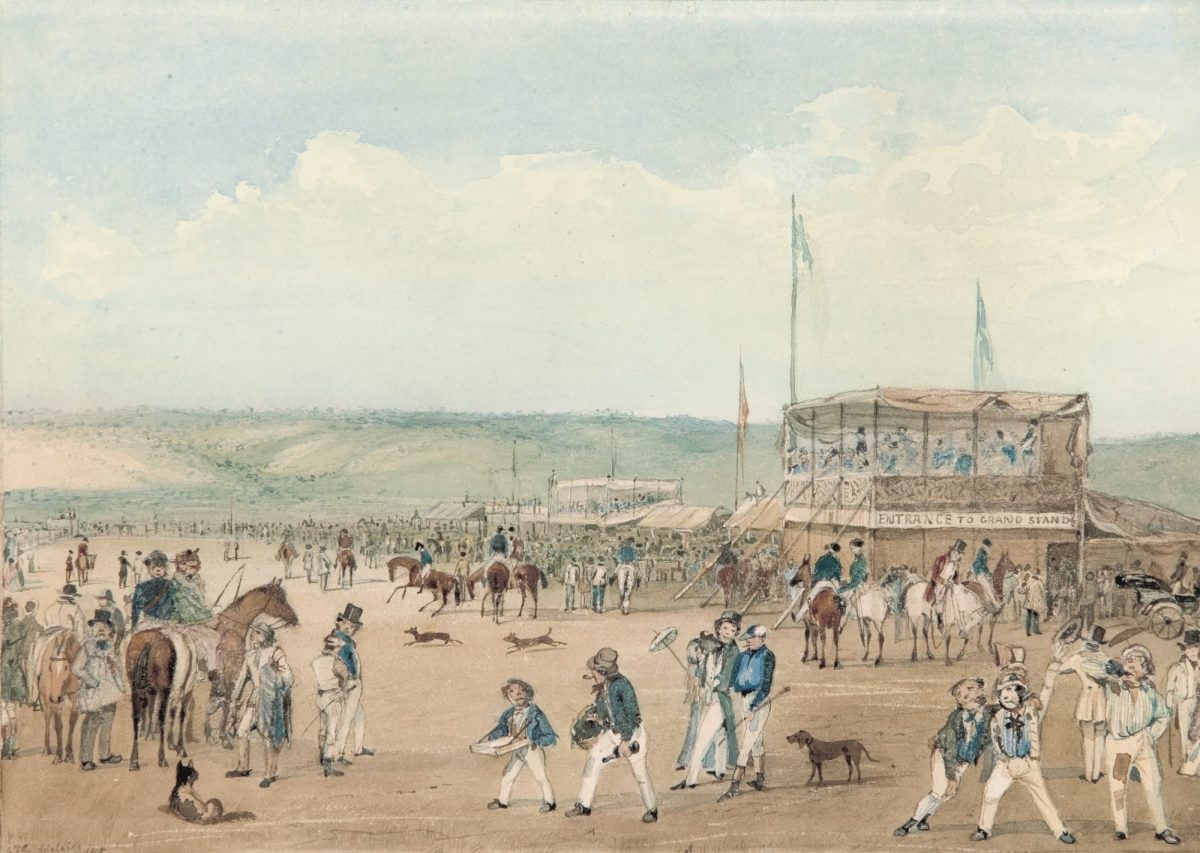 S.T. Gill - Scott Fakes and Adelaide Signatures
Several 'Gill' watercolours surfaced in the 1890s with connections to amateur artist Margaret Cochrane Scott nee Little and daughter journalist Winnifred 'Magpie' Scott. Two were fake. These and others had the uncommon 'STG Adelaide' signatures.
This project has advanced the dating of Gill's works. The dating is best seen in the Select Catalogue of Works.
Appleyard and Radford erred in dating Gill's Seasons and Months. Although the series is c.1847, not 1840-42, this didn't really impinge on the signature appendix. → S.T. Gill and Art History's Wrong Turn.
Shepherd and dog with sheep | AGSA 625D1 is signed "SG" – uniquely so for an Australian work. Although this AGSA work would have been available to Appleyard, he didn't include it.
With other works signed "SG" in Gill's English sketchbook, it's possible that "SG" is actually Gill's father, Samuel Gill senior. No-one to my knowledge has suggested this. I think on balance that Shepherd and dog with sheep is by Gill the son and this is an early South Australian work by him.
I found several works
→ S.T. Gill and E.L. Montefiore.
 I uncovered a concealed signature (black script on black background) on an Angas linked Corroboree watercolour. See: S.T. Gill and George French Angas, 1844-1845 | A Concealed Signature.
← Manipulated image of the signature on NLA NK2124, showing initials and perhaps a date.
Several watercolours for James Allen in 1845 have well-hidden "SG" on sacks:
Gill also used his initials as a horse brand, such as in Successfull Diggers on way from Bendigo and The Equestrian Digger.
Here are things to look for in Gill's signature:
Does it help? A bit. Some familiarity with Gill's signatures can help date a work, but this is far from straightforward.
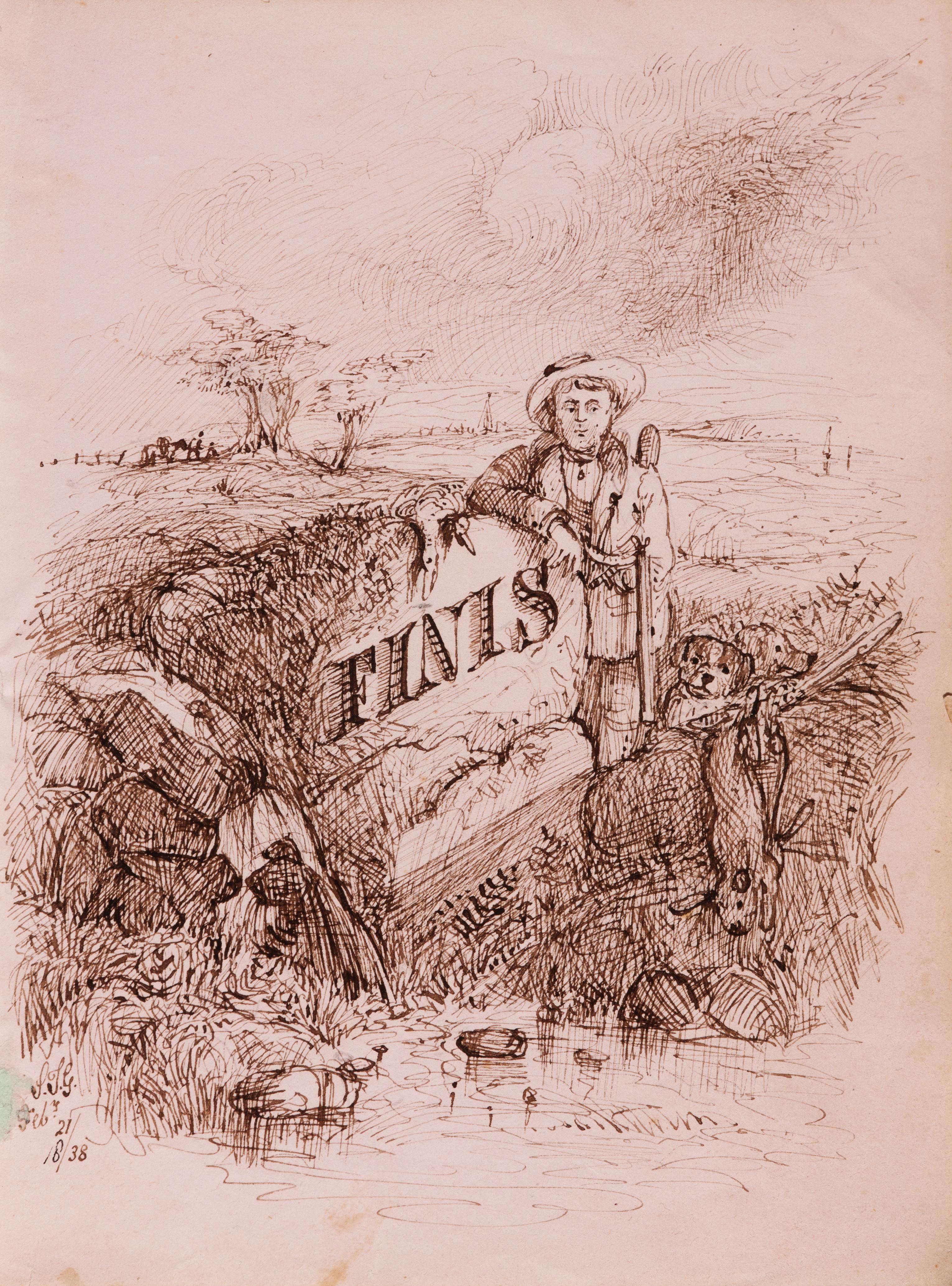 Sketchbook | Art Gallery of South Australia 659D34
Artist: Gill, S.T. | Date: 1835/187x | Appleyard cat. 1
Gill's sketchbook as a young man. Sketches precede South Australia, so are c.1830s. An exception is an 1860s/1870s pencil sketch on the back of another page in the middle with the "down on one's luck" theme .
Five images are online at AGSA: "Shipwrecked", signed "STG Jan'y 26/36"; "Furling the Sail", unsigned; "Finis", signed "S.T.G. Feby 21/38" (with century "18" added later); seemingly fishing boats in rough coastal waters, signed "STG" (Roman serif style); no. 75 (Coastal scene with ships at anchor and rowing boats), signed "STG" (cursive style).
Reproduced in McCulloch (1977) are: "The Coachman", signed "S T Gill Dec 30th/35"; "Father Confessor"; "The Widower", signed "S G Dec 21/35" and "S.G."; "Shipwrecked", signed "STG Jan'y 26/36" (all page 62); a battle scene, signed "STG" (page 82b); "The Crusader", signed "STG" (serif style) (page 82c).
Reproduced in Appleyard (1986): no. 16 (Young men and women), signed "STG"; no. 32 (The duel), signed "S T Gill"; no 75 (see AGSA online above).
Reproduced in Grishin (2015, p.22-29): "Furling the Sail", "Oh Who Has Heard" (a.k.a. "Shipwrecked"), "Finis".
125
David Coombe. Original 23 February 2026. Updated 17 June 2026. | text copyright (except where indicated).
CITE THIS: David Coombe, 2026, S.T. Gill - Signatures and Dating, accessed dd mmm yyyy, <https://coombe.id.au/S_T_Gill/S_T_Gill_Signatures_and_Dating.htm>