 david coombe history
SUMMARY: S T Gill's life and times in South Australia, from 1843 to 1844. In this period the economy is recovering and focus begins shifting to mining of copper, lead and silver. This article highlights the connection with James Allen who would play a major role in Gill's career. The narrative extends to January 1844 and the arrival of George French Angas to execute his South Australia Illustrated. (After this the narrative takes several branches.)
Article type: NARRATIVE
In this article ...
NOTE: Emphases (bold) in newspaper quotations are mine. Links in the body of the article open in a new browser tab.
Main characters (in rough order of mention):
In this article I usually refer to the artist simply as "Gill", or "Sam Gill" to distinguish him from his father Samuel Gill, senior.
Years of birth highlight just how young most were in the early 1840s.
South Australia in 1842 was a primary economy and wool was a major export. This was reflected in a promotional booklet published in London in January 1843.
"South Australia in 1842" was published London, January 1843 with three plates from works by SA artists E A Opie, J M Skipper and Theresa Walker. George French Angas (1822 - 1886) lithographed two. This is Angas' first published illustrations of South Australia.
In 1843 South Australia had an expanding agricultural economy and was coming out of depression.
Sam Gill is barely observed in 1843. So it seems most likely he was working the family section: Map | S. T. Gill - Adelaide District | Gill Section 863. However 1843 would be a turnaround year for the economy and Gill's prospects.
Increasing wool exports to England were important in the improving economy. The last wool ship of the season was loading at Port Adelaide when, on 25 February, it was reported that copper ore had been found in quantity. Four casks of ore were ready to be shipped from the Port!
A rich mine of copper ore has been discovered in Captain Bagot's estate to the North, and a sample of about a ton-and-a-half is about to be sent home by the Countess of Durham, with the view of testing its quality before anything further is done. The same vessel will also carry home about twelve or fifteen tons of Mr Osmond Gilles's lead ore from Glen Osmond.1
Mining had begun earlier near Adelaide with Osmond Gilles' small lead and silver mine at Glen Osmond. The copper find would add to that development and shift the economy. The ship departed 18 March with mineral ore from both sources.
The Countess of Durham, the last wool ship of the season, leaves Port Adelaide this day for London direct, having on board 581 bales of wool, 4 casks of copper ore, 2 casks of wattle gum, 96 sheep-skins, 640 tanned sheep-skins, 1036 bullocks' horns, 33 kegs, 19 bags, 12 blocks, and 273 pieces of lead ore, 30 tons of bark, 5 hogsheads of wheat, 5 casks of seal-skins, and various other articles of export, the produce of the colony. Of our staple commodity, wool, the Sultana took 1035 bales, the Sarah and Elizabeth 408 bales, the Taglioni 988, and the Countess of Durham now takes 581 bales, being in all 3012 bales, that is, nearly 500 bales less than was calculated upon in January last. With this abatement, however, we have strong grounds for confidence in our pastoral capabilities and resources, every year adding so sensibly to this branch of our internal wealth.2
George Dehane editorialised in his Examiner that South Australia's then poor reputation in England was being turned around, first by quality primary produce, and soon by mineral wealth.
... When the Countess of Durham may arrive in the London or the St. Catherine docks, the fact of the extensive and valuable mineral deposits, as they exist in this colony will be displayed to the eyes of every one. O. Gilles Esq., the enterprising owner of the Glen Osmond Mines, has sent home samples of lead and silver ore, and what is presumed to be nearly pure silver ore ... [of the ore samples] there are twelve lumps of pure Galena that weigh, together 22½ cwt., the largest piece being 363lb. weight. There will be no mistake as to where these came from and we understand Mr Gilles has given directions that every one who may come to the wharf for the purpose of satisfying themselves shall be allowed to take any number of samples away with them and that the same shall be forwarded to several of the Museums and learned societies in London.
Capt. Bagot has also discovered on his estate copper ore of a rich description, a considerable quantity of which has been sent home by the same vessel.
All these mines the Glen Osmond, the Wheal Gawler and Capt. Bagot's have been found actually upon the surface and generally on the slopes of ranges, which had given rise to the suspicion that they might be merely superficial deposits and it has led to very extensive excavations at a lower level and into the earth, but the result has been without exception an increase both in the quantity and the quality of the ore. Very great pains has been taken to ascertain the probable extent of these deposits in their particular localities, and the fact of the great extent of them has been made clear to a very large proportion of the citizens of Adelaide who have visited the mines in large numbers, and will probably send home corrobative accounts from a hundred pens ...
Success then to our Export Trade on which we must rely for the influx of CAPITAL and the renewal of Emigration!! 3
Money's reaction would await the English assays; however "a hundred pens" were inking optimism.
Meanwhile on the family front, Gill senior resumed his English profession of teaching, in May 1843 opening a boarding school for boys at Sturt Vale (on his section 863).
CLASSICAL and MATHEMATICAL PREPATORY SCHOOL, for a limited number of Young Gentlemen under twelve years of age. Coromandel House, Sturt Vale, conducted by SAMUEL GILL...4
This supplemented the agricultural pursuit. That year on section 863, Samuel Gill reported on his planted acres: eighteen planted to wheat, two to barley, and one-and-a-half as a garden.5
In June 1843, one "Samuel D. Gill" was listed as a subscriber to a new local publication, The South Australian Vigneron and Gardener's Manual.6 (Instead of a mistranscription, this may be Samuel Gill (senior) using middle initial "D" (for his mother's surname Delve) to distinguish himself from his son "Samuel T".)7
And in August, his wife Elizabeth (Murray) gave birth there to a daughter.8 The same month a curious letter to the editor appeared in the newspaper.
The Gills may not have even heard of daguerreotype before they migrated to South Australia in 1839, but by early 1843 they would have read at length about the photographic innovation in the newspapers and its commercial introduction to Sydney by George Goodman.
George Barron Goodman : Revealing the True Identity of Australia's First Professional Photographer | Sydney
Goodman arrived in Sydney with a daguerreotype in November 1842 and established a commercial photographic studio.
Interest in this and other scientific advances of the time prompted this intriguing letter to the editor of the Register in August 1843. The letter was from an eighteen year old William Cawthorne. He referred to a notice in the window of an Adelaide stationer advertised: "Correct Likenesses taken in ten minutes.–Hall's Gallery, Currie-street, West end." (Cawthorne's mocking tone suggests he didn't understand its meaning.)
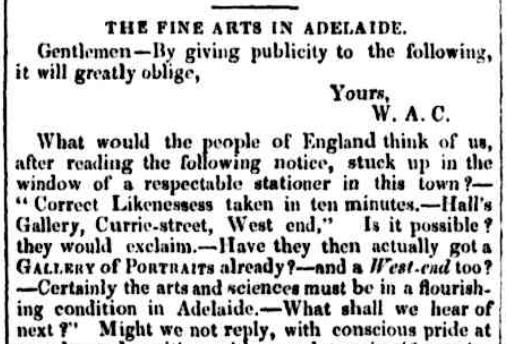 Correct Likenesses, 10 Minutes, Hall's Gallery, Currie-street, West end | August 1843.
Daguerreotype and early photography in 1840s South Australia: William Little, Robert Hall, Robert Norman, S T Gill, George Heseltine and G B Goodman. Captain Lucas of the French 'Oriental-Hydrographe' expedition and D N Joubert.
The gallery belonged to Robert Hall (1820/21–1866), who was arguably South Australia's premier early photographer. Could Sam Gill have been involved with Hall then? I think it's quite possible.
The more serious attempts at daguerreotype in Adelaide came in 1845. For more from 1845 on the imported daguerreotype aboard Augustus and Gill's use of photography, see: Daguerreotype and Early Photography.
In September 1843 an artistic opportunity came Gill's way. Surveyor-General E. C. Frome returned to Adelaide from a two month expedition exploring northwards, but minus his sketchbook.
He had, however, been so unfortunate as to lose his sketch-book (which contained some sketches of very beautiful scenes) and his drawing materials, which were accidentally destroyed by fire.9
Frome himself was a reasonable artist – an important skill for the surveyor. One of his party was James Henderson who also sketched on the expedition. But it was Gill would later work up pictures from originals by Frome and Henderson for clients such as E. J. Eyre and G. F. Angas.
 S.T. Gill - Subject - Extinct Crater
S. T. Gill's subject of an extinct crater is based on a (non-volcanic) rock formation seen on Captain E.C. Frome's 1843 northern expedition. Gill's crater views were probably based on a sketch by expedition member James Henderson.
Previous authors have noted that newspaper man James Allen commissioned Gill to sketch for his English promotional tour and have recognised the significance of this to Gill's career. However they missed the strong religious connection between Allen and Gill's father, which was likely foundational to that commissioning.
On Wednesday 6 September the first annual meeting of the "South Australian Missionary Society in aid of the German Mission to the Aborigines" was held at the Wesleyan Chapel in Gawler Place. Governor Grey was present to chair the meeting.
Two days later the Southern Australian reported the meeting in detail, adding this final note:
We are sorry to understand that towards the conclusion of the Meeting a disagreeable personal discussion arose, respecting one of the members of Committee. Having left early, we did not hear it, and think it unnecessary farther to advert to the subject.10
The next day, James Allen's Register newspaper, reported nothing exciting. Then the following week, newspaper rival John Stephens' Observer couldn't resist having a go at Allen. It reported that, after speeches and reports, there was a motion to appoint the society's committee and officers for the ensuing year.
But just as his Excellency was about to put the motion a most unseemly and indecorous interruption of the proceedings of the evening took place, which not only occasioned the withdrawal of his Excellency from the chair which he had so ably filled, but will probably lead to the retirement of many active and valuable members of the Committee, if not to the formation of a new Society.
The unmannerly breach of Christian decorum to which we have alluded was concocted by Mr James Allen, (whose name had been omitted from the list of the Committee for the ensuing year), and a Mr Gill, who, as Mr Allen subsequently informed the meeting, was there with his concurrence. Mr Gill rose from the body of the chapel, and without addressing himself to his Excellency or to the motion, indulged in some irrelevant remarks, concluding with a passing commendation of the officers whose names had just been read, but added that he regretted the absence of one name from the list, he meant Mr Allen's, and sat down by moving that his friend Mr James Allen's name be added to the committee.
A scene of indescribable confusion now took place, for which his Excellency was wholly unprepared, although we have reason to know that the denoument had been foreseen by some of the members present.11
(James Allen had been a strong critic of Governor Grey. Despite Allen being on the outgoing committee, his name was omitted for the new one. It was explained at the meeting his name had been omitted so the society could retain the Governor's strong support for their mission!)
Leaving aside the egos and local politics, this event reveals the close connection between two Baptist ministers: the newspaper man James Allen and the farmer-teacher Samuel Gill. Although it is already known that the reverend gentlemen were both Baptists, their personal connection has been previously overlooked. The Observer report clearly portrays the pair as friends and allies.
All were soon distracted by an economic quandary.
The previous growing season had seen crops left in the field due to a lack of harvest labour, and at the time a committee had been formed (which included James Allen).12 Attention turned to mechanical harvesting and from September 1843 there was a new subject of consuming interest: reaping machines. A competition was conducted for plans and models of effective machines. The ever busy James Allen submitted an entry!13 (John Ridley was ultimately successful.)
At this same time there was a hint of increased economic activity and the possibility that the escape to the country may soon be reversed.
Whilst some of the outskirts of Adelaide have been almost depopulated by the departures of their residents into the rural districts, (now found to possess a variety of attractive charms and solid inducements), departures which have left their town tenements scarcely in a condition to answer the purpose of Shakespeare's apothecary's "empty boxes," it is gratifying to perceive the renewed progress of buildings and improvements in the principal streets.14
Half a world away in England, in August, the latest ship arrived from South Australia. The Countess of Durham arrived in London with its copper ore on 14 August after a five month passage.15
Two days later, the London monthly South Australian News, 15 August edition, was available.16 The News had just enough time to report the ship's arrival with copper ore, to get off the South Australian newspapers (dated up to the ship's departure on 18 March) and report on them.
How much was known about the quality of the copper ore before the South Australian News went to press? Could a quick assay have been done before the ore was onshipped? Had South Australian Company chairman George Fife Angas gone aboard to see the ore for himself?
There was some incredulity in London regarding the lead ore:
On the arrival of the Countess of Durham in England, the Collector of Customs, it is said, would not believe, that the ten tons shipped by Osmond Gilles, Esq., in that vessel, was the produce of South Australia, and required duty to be paid upon it as foreign ore. Captain Hart, of the Sarah and Elizabeth, our informant adds, on being applied to, came promptly forward, and relieved the Collector from his difficulties, by deposing to the fact of its being South Australian produce.17
But it was the copper ore that would most boost the South Australian economy. One wonders if the assay results were made public, or at least were known by George Fife Angas.
Was it coincidence that an anonymous advertiser in the News was wanting to buy shares in the South Australian Company?
The same edition of the South Australian News also reported George French Angas (1822–1886) had a prospectus for a grand work, South Australia Illustrated.
This confluence of these events appears to be no coincidence.18
As Fife Angas' eldest son, French Angas could have become a businessman or grazier, but aspired to be an artist.19 His first commercial artistic foray in the Mediterranean had proved unremunerative,20 but South Australia's prospective mineral wealth had potential for a stronger market for his work. The paper quoted from the prospectus, while adding some reservation about the price:
Judging from the known ability of the intended Author, from the enthusiasm he feels in the work, from the special advantages he will enjoy in the prosecution of his labours, we promise very much gratification both from his pen and pencil. The enterprize is a spirited one, worthy of support, and though the price of the intended work is considerable, we do not think it at all unreasonable ...16
Angas would indeed enjoy special advantages in assistance from Governor George Grey in South Australia.
But it was another few months before this French Angas' news (and then his person) would reach Adelaide.
In October bright news came from England on the quality of Osmond Gilles' lead ore.21 Even more significantly the following month came news of the copper assays for Bagot's Kapunda, assessing it far superior to the ore from the rich Chilean mines.22
French Angas' announcement also arrived in November – just before Angas himself. Gill would have read it in the Adelaide Observer.
South Australia is to be illustrated. Mr George French Angas, author of "A Ramble in Malta and Sicily," &c., and eldest son of G F. Angas, Esq., encouraged by the success of his volume on Malta and Sicily, has announced to the English public his intention to visit this distant portion of the British Empire, and to publish "South Australia Illustrated."23
Where was Gill when he read this? The Gills were on the family section; was Sam Gill with them? Like all of South Australia, Gill knew of the father, George Fife Angas, chairman of the South Australian Company. But did he know of the son who had only just reached his majority? The newspaper continued:
In his prospectus Mr. Angas states that though ample justice has scarcely been done to the hitherto explored regions of the vast continent of Australia, yet the works of many intelligent writers and travellers have left little to be wished for by their readers at home, as far as the powers of description alone could go. They themselves, however, are found frequently regretting that no language can convey a just idea of the many objects of interest which have arrested their attention, and which they have done their best to describe. The pictorial specimens which have been given, are in general rather explanatory than illustrative – embellishments to their volumes, rather than portraitures which should realize in the mind the scenes which excited their admiration. The work now announced by Mr Angas will embody an attempt to reverse this method of description aided by meagre illustration, into that of vivid illustrations explained by brief description – such illustrations as he hopes will gratify the present laudable predilection for that class of publications.
Angas was to make a grand pictorial work, along the lines of John Gould.
It would be unlike his own Malta and Sicily book of 1842 which was long in description. For those fourteen plates Angas had transferred his "on the spot" views onto stone for lithography. His introduction had credited his drawing teacher under whom he had been a "professional pupil" for just four months. He was now ambitious for greater artistic renown. The Observer continued:
With this object in view, he has devoted the two last years to the necessary preparatory studies; and is possessed of some specific advantages which will further aid him in carrying out his plan. His drawings will include every feature of interesting novelty in Southern Australia : the magnificent mountain and landscape scenery, lakes, lagoons, rivers and waterfalls, hills and valleys, forests of new and strange vegetation, coast scenery, islands and harbours–sketches of our settlements, with their flocks and herds, their cities, towns, and villages; portraitures of the Aborigines – their war costume, and domestic habits; also, such specimens of natural history as are not comprised amongst those so well exhibited by Mr Gould in his splendid work on the birds. The whole will be accompanied by descriptive and explanatory details, anecdotes, and such particulars (including a notice of the establishment, settlement, and progress of the Colony) as may be gleaned by unwearied research, aided by the advantage of numerous letters of introduction–all combining to render the work as interesting as possible.
John Stephens' Observer could see the advantages such promotion would bring to South Australia, but was troubled the book would be unaffordable to all but the wealthy.
Mr Angas's projected attempt to illustrate the Colony by a series of splendid views of its settlements and scenery is a bold one ... and one which will not only be gratifying to our fellow-Colonists, but may be the means of making the Colony an object of attraction to many in the Mother-Country and elsewhere. We fear, however, that Mr Angas's plan of publication will be too expensive to place his work, tempting though it be, within the reach of many except the millionaires. It is to be published in Imperial folia parts, the size of Mr Gould's "Birds," and completed in not more than ten parts. Each part is to appear at an interval of two months, and contain five plates done in the very finest style of tinted lithography, with letter-press descriptions. The price to subscribers, will be 21s. each part; non-subscribers, 25s. We must not omit to mention that the work is under the patronage of Queen Adelaide and other distinguished persons.
Lofty patronage!
James Allen reproduced the prospectus in the Register and wished Angas well in advance.
We need not say, how heartily we wish Mr Angas success in his project, or how cheerfully we shall hail his visit to our shores for such a purpose.24
What did Gill make of this? Gill had backing of neither the Queen nor the influential chairman of the South Australian Company. He also lacked Angas' sense of entitlement. There wasn't a lot of room in South Australia for professional artists. But Angas' grand and expensive ambition was a different market. If Gill was to make his living in South Australia as an artist instead of a farmer he needed to make his presence felt. (We'll see later how Gill leveraged Angas' project.)
Meanwhile a party of gentlemen took a leisurely sailing to Port Lincoln. J.M. Skipper (1815–1883) showed the Observer's John Stephens his resulting portfolio with five titled sketches.25 There was no mention of Gill, and the trip may have been to him an unaffordable luxury.
On the last day of 1843, George French Angas arrived on the barque Augustus to begin his magnum opus, "South Australia Illustrated".
Also aboard was J.F. Bennett returning to the colony after publishing a little book in London: Historical and Descriptive Account of South Australia. This seems to have been the textual basis for a set of South Australian scenes Gill did for Bennett after his return.
Set of 8 wash drawings of South Australian scenes - natural, Aboriginal, rural and the built environment, corresponding with subjects in J.F. Bennett's book. Some have "Bennett" inscribed on the reverse.
Arriving in Adelaide, Angas wasted no time in seeking Adelaide subscribers for his South Australia Illustrated project, just as he had done in London.
Under the especial Patronage of Her Majesty Queen
Adelaide.
ILLUSTRATED WORK ON SOUTH AUSTRALIA. To be Published by Subscription. In Imperial Folio Parts.
SOUTH AUSTRALIA ILLUSTRATED :
comprising its Mountain, Forest, and General Landscape Scenery, Towns, Villages, Coasts, and Harbours, Portraitures of the Aborigines, War Costumes, Domestic Sketches, and Natural History. Accompanied by Descriptive Details and Anecdotes.
By GEORGE FRENCH ANGAS, Author of "A Ramble in Malta and Sicily," &c ...26
As well as the artistic passenger, Augustus brought good news on the copper assay. Captain Bagot began mining.
Some time ago we published the particulars of a highly favorable assay, which was made in London, of the copper ore discovered by Capt. Bagot on his land in the County of Light. We have now the farther satisfaction of stating that information has been received, per the Augustus, by parties in town, of the assay of lead ore from the Glen Osmond mines, sent home by the Countess of Durham and other vessels ...
We understand that Captain Bagot has commenced operations at his mines, and, of course Mr Gilles and probably others will now commence the Glen Osmond mines in right earnest, and without delay ...
The magnificent and immense resources of this favored land must speedily be made known, one way or other, and South Australia will become what nature has destined her to be, a great, rich, and prosperous country. For this end all we want are fresh capital and more labor. For the latter the colonists must keep petitioning the Colonial Office till they get it, and capital is sure to come along with it.27
Hope was rapidly giving way to optimism.
England wanted to know more of South Australia. Robert Hall, whose "Correct Likenesses taken in ten minutes" poster attracted Cawthorne's attention just five months earlier, advertised souvenirs for sending back to England.
PRESENTS FOR ENGLAND.
THE undersigned begs to inform his friends and the public that he has on hand an extensive and very superior collection of STUFFED BIRDS, well adapted for the selection of those who desire to send to England choice and unique specimens of the Ornithology of this Colony. He will be happy to treat with gentlemen or ladies intending to send collections to their friends or who may be returning to England.
ROBERT HALL, Ornithologist, West end of Currie-street.
N.B. A large quantity of live birds for sale, consisting of emus, white cockatoos, red cockatoos, cockatoo-parrots, blue mountain parrots, grass parroquets, purple-headed parroquets, plovers, &c. &c.28
On 17 January, W.A. Cawthorne (1824–1897) bumped into his former boss, Anthony Forster, the South Australian agent for George Fife Angas, and with whom George French was staying. It's clear Forster and Angas had already planned a major role for Cawthorne in telling Angas all he knew "about the Natives for his intended work".

Cawthorne and Angas | 1844
Cawthorne worked unpaid for Angas during the latter's South Australian visits in the first half of 1844 and first half of 1845.
In January E.L. Montefiore (1820–1894) moved from Hindley Street to newly completed store and residence on acre 108 (the corner of Grenfell and King William Streets).
Mr Montefiore has also just finished a large, good store in King William-street, and a dwelling-house on the same acre, in Grenfell-street.29
Gill sketched these prominent landmarks several times – in their own right, and also as prominent background in his portrayals of "Sturt's Departure, 10 August 1844". The connection between Gill and Montefiore is further explored in:
 S.T. Gill and E.L. Montefiore
Eliezer Levi Montefiore – businessman and Gill student. Shown here are Montefiore's store and dwelling.
This page and the previous one have been narrative in nature. But after this articles take on a more thematic character and are a blend of catalogue and narrative.
Angas' South Australia Illustrated turned out more of an opportunity than a threat, with Angas seeking to use others, including Cawthorne and Gill, to help him accomplish his grand work.
Following are a few pages that include Gill's work in 1844.
Lieutenant John Napier Magill (1819-1848), 96th Regiment, posted to South Australia 1842-1846. Magill was a flautist and artist, painting views of Flinders Street barracks. Gill watercolours for Magill and Captain W.D. Chard.
 S.T. Gill, E.J. Eyre, Symmetry 1844
On 16 December 1844 explorer Edward John Eyre departs Adelaide on the barque 'Symmetry' for England, taking with him paintings by Gill. Gill illustrated scenes for Edward John Eyre between May and November 1844.
 S.T. Gill at Angas' Barossa 1844
S. T. Gill was in the Barossa sketching for the Angas family from 29 October to 4 November 1844. I identify some works as well as influences on Angas publications "South Australia Illustrated" and "Barossa Range and its neighbourhood".
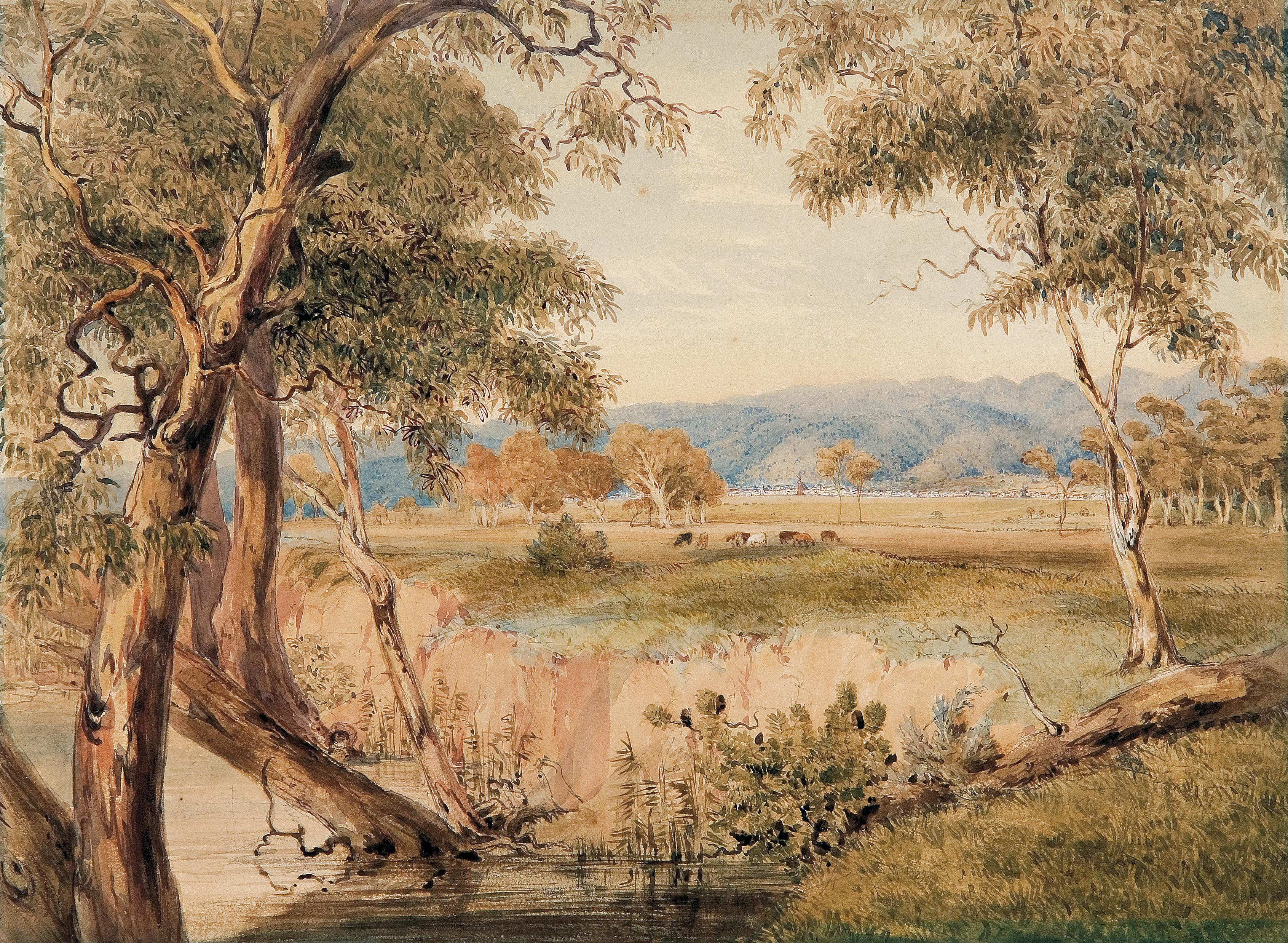 S.T. Gill and George French Angas, 1844-1845
1844-45. George French Angas made a splash in South Australia in two visits (interrupted by a trip to New Zealand). He left on 2 July 1845, a fortnight after his art exhibition and its associated controversy.
David Coombe, original 26 November 2025, updated 4 December 2025. | text copyright (except where indicated)
CITE THIS: David Coombe, 2023, S.T. Gill - Narrative, 1843 to 1844, accessed dd mmm yyyy, <https://coombe.id.au/S_T_Gill/S_T_Gill_Narrative_1843_to_1844.htm>