 david coombe | history
SUMMARY: Works by S.T. Gill in the period 1839 to 1844 and not included elsewhere in the catalogue.
Article type: CATALOGUE and ANALYSIS
In this article ...
S. T. Gill arrived in South Australia in mid-December 1839, part of the family group made up of his parents, brother and sister.1
So it may seem surprising that Gill's earliest self-dated South Australian works are 1844. There are no extant works by Gill that he himself dated 1840, or 1841, or 1842, or 1843. There is nothing until November 1844. Some works have been previously dated between 1840 and 1843 based on an incorrect dating conclusion by Appleyard and Radford. (See: S.T. Gill and Art History's Wrong Turn.)
Perhaps a lack of works for this period may be partly explained by more of Gill's earlier (less accomplished) works having been lost over time – more so than works from his later career.
However I do attribute some works to this period 1839 to 1844. A few of them appear here in this article; others are documented in these articles:
A few works from the above pages are also repeated here for context.
On 7 March 1840 Gill advertised himself and his artist studio in Gawler Place, Adelaide. (Gawler Place was shorter then and ran just the single block between Rundle Street and Grenfell Street.)
S. T. GILL, Artist, &c., late Draftsman and Water Color Painter to the Hubard Profile Gallery of London, begs to announce to his friends and the public generally of Adelaide and its vicinity that he has opened rooms in Gawler-place, where for the present he solicits the attendance of such individuals as are desirous of obtaining correct likenesses of themselves, families or friends. Parties preferring attendances at their residences may be accommodated without additional charge. Correct resemblances of horses, dogs, etc., with local scenery, &c. executed to order. Residences sketched and transferred to paper suited for home conveyance. Orders executed in rotation.
Open daily from eleven till dusk.2
Gill's advertisement in the Register is usually cited as the start of an upward trajectory. But his artistic career was yet to flourish. We can see this from a fresh narrative perspective: S.T. Gill - An Early Narrative, 1839 to 1842 | Artist Studio in Gawler Place: An Advertisement | March 1840.
Early among "residences sketched" was John Walker's house (and stores) on Hindley Street. SLNSW has two similar views of this:
Both show Walker's house and stores but the pencil sketch is a wider view taking in more of the streetscape. Examining the detail, the watercolour shows a brick and iron fence in front of the house, whereas the pencilled house seems to have a paling fence that is continuous with the store and has a central gap. This could suggest the pencilled sketch predates the watercolour.
Borrow (1956) attributed the watercolour to Gill. But after Appleyard and Radford (1986) redated Gill, this became a difficult position to hold; and consequently the picture was reattributed to Walker's sister-in-law Martha Berkeley (Lock-Weir 2005, 110; Hylton 2012, 58). But the current author having identified the Gill Art History Wrong Turn, the watercolour can confidently be brought back into the early Gill catalogue.
Authorship of the pencil sketch is less certain, but Gill would be the lead candidate.
Gill's early clients included Captain John Walker, J.A. Horrocks and Governor George Gawler.
As well as sketching for private clients, Gill may have sold his early Series of Adelaide Views directly or through a store such as Charles Platts' music and stationery shop (just as he is known to have done later in 1846 before leaving on the Horrocks expedition). Platts' advertisement came a month after Gill's:
JUST ARRIVED, STRAUSS'S Waltzes, and other music; violin, harp, and guitar strings, &c.; books, maps and atlasses, in great variety; stationery.
C. PLATTS, Gilles-arcade.3
Gill's sketches were likely the sources for a series of engravings in 1841 by H.C. Jervis.
In early 1842 the army arrived in South Australia and from then Gill had clients among army officers such as J.N Magill, 96th Regiment.
In early 1844 Gill sketched South Australian scenes - natural, Aboriginal, rural and the built environment, likely based on subjects in J.F. Bennett's book "South Australia in 1842".
For a narrative perspective which includes some of these works, see:
To see these works, with accompanying notes, just scroll down or jump to the List of Works.
Borrow, K.T., (1956). Early South Australian pictures (1802-1856). Proceedings of the Royal Geographical Society South Australian Branch, Session 1955-56. <https://catalogue.nla.gov.au/catalog/2312105>
Lock-Weir, Tracey and Art Gallery of South Australia. Visions of Adelaide : 1836-1886 / Tracey Lock-Weir Art Gallery of South Australia Adelaide, S. Aust. 2005
Scroll down to see all pictures along with detailed notes or click a link to jump to a specific work from the list.
 Hindley St. Adelaide 1838 - No.1 built by J. Walker Lieut. R.N. | Mitchell Library, State Library of New South Wales SSV/42
Artist: Gill, S.T. (likely) | Date: 1840-01~/1840-07~ | Appleyard cat. n/a | 15.4(H) x 20.4(W) cm
Catalogue: S.T. Gill - Works - 1839 to 1844
A pencil sketch of the south side of Hindley Street, acres 74 and 75, from Captain Walker's store and dwelling (left) to Hack's (right). Note the Aboriginal people (left and right foreground).
The significant buildings (left to right) are John Walker's timber stores, Walker's stone or brick house (at least part of which was the Town Council Room from January 1841) (acre 75), William Williams' building (later South Australian (SA) Club House from May 1839 and improved from January 1841) and J.B. & S. Hack (later H.W. Phillips & Co.) (both acre 74) - all of which are recorded on the 1842 Kingston map. Williams' building was initially a store, then his Victoria Hotel before being sold to the SA Club. The sketch may or may not predate the Club occupancy from May 1839.
Inscription on back in pencil (except for the year which is in ink) - slightly different text in SLNSW catalogue: "View In Hindley Street Adelaide. / House with verandah and store on the left are Mr Walker's. / House in centre with post and chain in front is the club house. / House on right is Mr Hack's / J. S. Walker / Adelaide 1st (?) August / 1838". "1838" was appended later in ink. It's not clear what the date applies to - sketch or annotation? (If it's the sketch date, it would predate Gill's arrival.)
"W. WILLIAMS begs leave to inform his Friends and the Public that he has commenced business as Auctioneer for the sale of Land, Cattle, and Timber of all kinds, upon Acres Nos. 74 and 75, Hindley-street, situated between the stores of J. B. and S. Hack and Captain Walker, where there has been just erected an extensive sale Room, with a large and covenient Stock Yard in front."
South Australian Gazette and Colonial Register, 13 October 1838: 2. <http://nla.gov.au/nla.news-article31750180>
The acre 75 property was transferred from Charles Berkeley to brother-in-law John Walker 6 September 1838 (Butler 2018). Walker's house was built in 1838/1839.
The view and style is comparable to "House of Lieut. John Walker R.N. Hindley street Adelaide built 1839" (SLNSW-M SSV/43) (by Gill) though this is a wider view. Noticable in both is a tearaway two-wheel buggy. The watercolour may have been developed from this pencil sketch. Both works likely date to early 1840.
References:
* Reg Butler, 2018, Adelaide Streets History, accessed 11 Jun 2021, https://localwiki.org/adelaide-hills/Adelaide_Streets_History
Map | S. T. Gill - Adelaide
524
 House of Lieut. John Walker R.N. Hindley street Adelaide built 1839 | Mitchell Library, State Library of New South Wales SSV/43
Artist: Gill, S.T. (attr.) | Date: 1840-01~/1840-07~ | Appleyard cat. n/a | 18.6(H) x 33(W) cm
Catalogue: S.T. Gill - Works - 1839 to 1844
John Walker's house (right) and stores (left) on Hindley Street (half of acre 75). The 1842 Kingston map shows the house (brick or stone building), the stores (timber building) and behind the stores the Town Council Room (brick or stone). It was reported in February 1844 the timber stores were being demolished for a leather warehouse.
Reverse ink inscription: "House of John Walker, Lieut. R.N. Hindley street Adelaide built 1839".
Walker was in financial difficulty and the property was put up for sale in July 1840. Walker was reported insolvent in August 1841. Gill advertised professionally from March 1840: "Residences sketched and transferred to paper suited for home conveyance", this painting aligning with his target market.
There is damage at lower left where a signature may have been placed, but nothing can be distinguished.
This painting has devices that are typically Gill - the busyness of the scene, the tearaway two-wheel buggy, the mother and child, the dog running in the street, the horse's rear end and the whips. But even more significant is Gill's characteristic eucalypt trees. Here they are much like Gill's "Former barracks in Grenfell Street, Adelaide, S.A., also the Wesleyan Methodist Chapel, Gawler Place" (NLA NK2038/30) (but are not like Martha Berkeley's).
The subject and style is similar to the pencil sketch SSV/42, though this is a narrower view and the Aboriginal people are no longer included. The pair are probably by the same artist, though the pencil sketch is less obviously by Gill. It's likely Gill is the artist for both and they date to early 1840.
Map | S. T. Gill - Adelaide
511
Front, Methodist Chapel, Gawler Place | National Library of Australia NK2038/08
Artist: Gill, S.T. | Date: 1840~/1841~ | Appleyard cat. n/a
Catalogue: S.T. Gill's Series of Adelaide Views
The newly built Wesleyan (Methodist) Chapel opened in July 1839 in (acre 106) Gawler Place (which then ran only between Rundle and Grenfell Streets). In the background are other buildings in the city, including an industrial chimney stack.
The H. C. Jervis engraving of this building (SLSA B 4500) shows it surrounded by a neat iron fence and, if that is an accurate portrayal, suggests Gill's scene is earlier. Gill advertised his artist's rooms in Gawler Place in March 1840 so this could be one of his earliest colonial works.
Series of Adelaide Views 11 (from reverse inscription).
Map | S. T. Gill - Adelaide
54
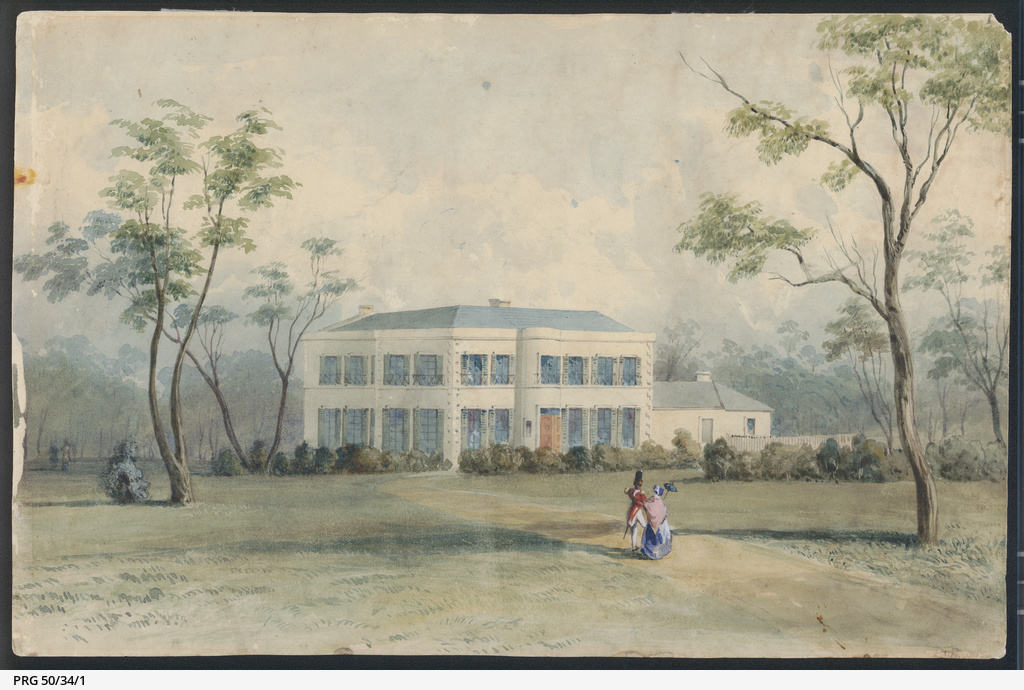 Government House | State Library of South Australia PRG 50/34/1
Artist: Gill, S.T. | Date: 1840~/1841-06~ | Appleyard cat. n/a
Catalogue: S. T. Gill's Government House for George Gawler
Government House is on the Park Land above North Terrace and to the east of King William Street. Here it is viewed from the south-east from within the grounds.
This work is in a collection of paintings from the Gawler family. At time of research this work was attributed in SLSA to Governor George Gawler (who departed Adelaide in June 1841 the month after he was replaced as governor by George Grey). Several scenes and works in this collection are dated December 1839 to 1840 including a few by J.M. Skipper. This picture is likely contemporaneous. The new Government House was built during Gawler's governorship and it's likely this work was for him. This is the earliest known picture of the new Government House completed in late 1839.
This work is almost identical to another by Gill - AGSA 0.34 - in particular in viewpoint, extent, building detail and significant (gum) trees. The military officer and lady are Gill's in style. In contrast this view has fewer characters and so lacks the greater busyness of the AGSA work. The foreground vegetation technique is more subtle than Gill's later works.
The 96th Regiment only arrived in October 1841, so who is the officer and lady? Given the context, it seems likely that this is the Governor, Lieutenant-Colonel George Gawler, late of the 52nd Regiment, and Mrs Gawler. Captain George Grey, Gawler's replacement as Governor, arrived on 13 May 1841. Perhaps Gawler sought this picture as a souvenir of his governorship after he became aware of his recall or, this was a gift to him on his departure. Whether it was a commission or a gift, it would be no surprise that a picture for Gawler, might feature him.
Map | S. T. Gill - Adelaide
766
Former barracks in Grenfell Street, Adelaide, S.A., also the Wesleyan Methodist Chapel, Gawler Place | National Library of Australia NK2038/30
Artist: Gill, S.T. | Date: 1841-10~/1842-10~ | Appleyard cat. n/a | 12(H) x 19.1(W) cm
Catalogue: S.T. Gill and John Napier Magill
The view is to the northwest from Grenfell Street (foreground) near the intersection with Gawler Place (leading up to the right). At left are the double storey buildings in Grenfell Street (acre 106) used as military barracks in 1841-1842. These buildings were previously August and Cooke's stores, the store to barracks conversion being completed in October 1841 for the just arrived 96th Regiment. At right is the Wesleyan Chapel (southern wall) in Gawler Place (acre 106). The cottages between appear to be prefabricated Manning's houses and may have been officers' quarters. It looks like Montefiore's buildings (acre 108 on the corner of King William Street) are just visible (red wall) at far left.
These barracks were only used for twelve months. Replacement barracks in Flinders Street were reported nearly ready for occupation in October 1842. The "former barracks" caption implies this work was labelled after the regiment moved to Flinders Street. Yet the presence of two guards at the front suggests the work was painted while the barracks was still occupied, with the caption added later. This gives a likely date for the watercolour of October 1841 to October 1842.
For more detail see the catalogue / main entry.
Map | S. T. Gill - Adelaide
76
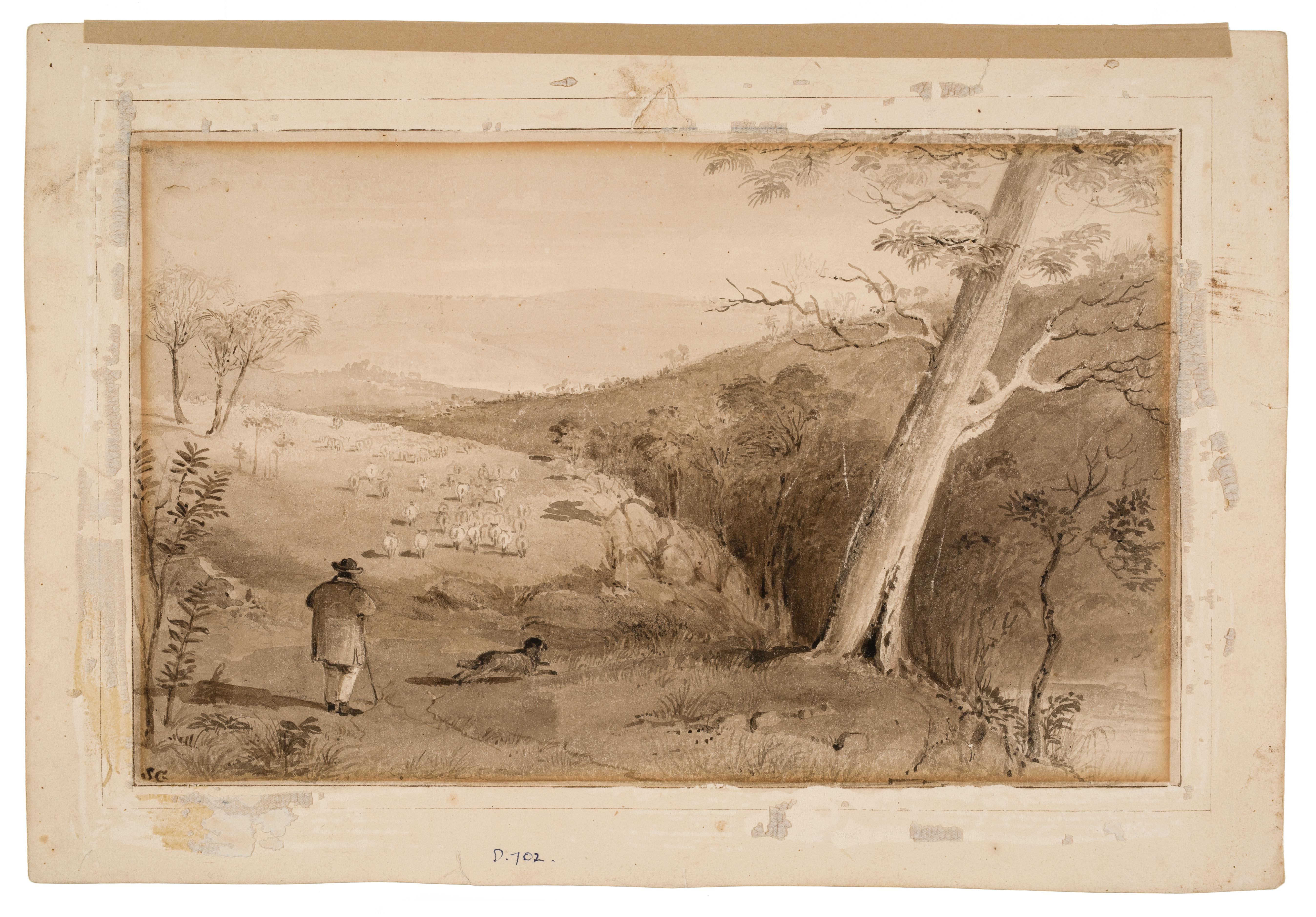 Shepherd and sheep near Burra | Art Gallery of South Australia 625D1
Artist: Gill, S.T. | Date: 1841~/1844~ | Appleyard cat. n/a | 27(H) x 39.6(W) cm
Catalogue: S.T. Gill - Works - 1839 to 1844
A shepherd and his dog minding a flock on the side of a hill. The man wears a heavy coat, a broad-brimmed hat and carries a staff. The dog races off in the direction of the watercourse (seen at lower right). The topography is very hilly and mountains are in the background. Featured is a gum tree - stocky looking with little leaf. It is very similar to the prominent tree in "Agricultural and Horticultural Exhibition, Adelaide, 1845" (NGA 2012.25).
This work is signed "SG" - uniquely so for an Australian work. However this signature is shared with "The Widower" (1835) in Gill's English sketchbook (AGSA 659D34). These factors suggest this is an early South Australian work by Gill. Also similar to SLNSW-DL DGA 58 f.68 "Coursing".
This picture is on thick paper. At the time of writing this work was titled "Shepherd and sheep near Burra", but the topography seems not well matched and the scene could be many locations (or none). Could it be near the Gill's section on the upper Sturt River? This work was purchased in 1962 from L.S. Kingsborough who provided the title "Shepherd and sheep near the Burra". James Hein's run at Burra Creek was noted in August 1844. Gill had reason to visit Burra in late 1845 for James Allen. The style predates that. As the Burra title may be inaccurate, I've suggested an alternative title.
See also S.T. Gill - Subject - Shepherd.
421
 On the Murray, below Mr C's Station. c.1846/47 | Flinders University BORR/X0/Picture rack/17
Artist: Gill, S.T. | Date: 1841~/1845~ | Appleyard cat. n/a
Catalogue: S.T. Gill - Works - 1839 to 1844
The scene is a slow meandering stream with two central eucalypt trees (probably stringy bark) at the stream edge and cattle resting beside it. The larger tree is reflected in the stream. Low hills are in the background.
This wash drawing was a gift from the estate of K T Borrow in 2005. Notes on the backing paper - probably by Borrow - are as follows: "On the Murray, below Mr C's Statton. c1846/7. Vide verso. x Mr A Cooke. Between Wellington & Lake Alexandrina. By S.T. Gill. Secs. 374, 382 ..." Borrow may have extrapolated from Mr C to Mr Cooke. However this is not the broad river one would expect to see between Wellington and Lake Alexandrina. The location, and so also the title, seem to be in error. There is nothing specific in this generic scene to identify its location or for whom it was painted.
The image is consistent with early Gill work, with a characteristic stocky looking gum tree without a lot of leaf. Signed "STG".
It is quite similar to the watercolour "The Gawler River" (AGSA 795HP30) (with tree reflection) and to a lesser extent "Rhodes's Cattle Station on the Gawler" (AGSA 986P53). The resting cows are very similar to "Woody range near Government Farm S. Australia March 26/45" (SLNSW-M PXD 39 f.07).
123
Camp Site, River Murray | Art Gallery of South Australia 0.1911
Artist: Gill, S.T. | Date: 1841~/1844~ | Appleyard cat. n/a | 24.5(H) x 37.1(W) cm
Catalogue: S.T. Gill - Works - 1839 to 1844
Looking down onto a sweeping bend of a river. Below, near the water, are scattered gum trees and reeds. There are two huts (one with a smoking stone chimney), two tents, and two animal holding yards. There are two Aboriginal men and a European man. A track runs past the structures. A manned small sail boat, possibly a ferry, is near the bank. Two colonists stand on an overhanging ledge. A man (smoking a pipe) and a dog sit looking on this scene below. Hills are in the background left.
The location is probably a crossing on the lower Murray. Two early crossings were shown in "Plan of the South Australian Company's Runs at Lakes Victoria and Albert" (1847) (SLSA BRG 42/119/4): Wellington and the Upper Crossing Place (Woods Point just above Tailem Bend). This scene may be the latter.
The substantial building could be (what was later known as) Thomas Wood's "Ferry House", at Morphett's Crossing place on the Murray, for which Wood took out a wine and beer licence in June 1845. Adelaide Observer, 28 June 1845: 8. <http://nla.gov.au/nla.news-article158920414>. A hotel, stores and houses were erected at Morphett's Ferry before April 1841. South Australian Record and Australasian and South African Chronicle (London), 17 April 1841: 8. <http://nla.gov.au/nla.news-article245933634>.
AGSA 0.1910 and 0.1911 are alike in size, scene, style and colour.
Map | S. T. Gill - South eastern South Australia
785
River Murray scene | Art Gallery of South Australia 0.1910
Artist: Gill, S.T. | Date: 1841~/1844~ | Appleyard cat. n/a | 24.2(H) x 37.2(W) cm
Catalogue: S.T. Gill - Works - 1839 to 1844
View of the Murray River from a vantage point with three Aboriginal men and a European man. Apart from the hill vantage point the view is generally flat with no cliffs, many reeds and few trees. There are three people in a rowing boat.
AGSA 0.1910 and 0.1911 are alike in size, scene, style and colour. This may be a similar location - probably the lower Murray. The scene is also similar to the retrospective "Mr Metcalf's Station / R. Murray / So. Australia / 1844" (AGSA 6310D4).
555
David Coombe. 2021-2025. | text copyright (except where indicated). This page: 28 November 2025. Updated 21 December 2025 (SLNSW images).
CITE THIS: David Coombe, 2025, S.T. Gill - Works - 1839 to 1844, accessed dd mmm yyyy, <https://coombe.id.au/S_T_Gill/S_T_Gill_Works_1839_to_1844.htm>