 david coombe history
SUMMARY: S T Gill's life and times in South Australia, from his arrival 17 December 1839, to 1842. With little to construct a biography, this is more of an narrative constructed largely from context: familial, economic and art scene. This highlights the rural economy and Gill's clients and connections such as John Horrocks, Governor Gawler and posted army officers. It places Gill less in the studio and more on the family's rural section.
Article type: NARRATIVE
In this article ...
NOTE: Emphases (bold) in newspaper quotations are mine. Links in the body of the article open in a new browser tab.
Main characters (in rough order of mention):
Years of birth reveal the youth of many in the early 1840s.
In this article I usually refer to the artist simply as "Gill", or "Sam Gill" to distinguish him from his father Samuel Gill, senior.
In writing about the artist Samuel Thomas Gill, the challenge all have faced is an abundance of undated artworks and a lack of biographical sources. (See About | A Challenge of Biography.) There are no known Gill diaries (Horrocks expedition aside), letters, account books, or colonial sketchbooks.
Appleyard and Radford (1986) erred in dating Gill's series The Seasons and the Months to 1840-1842 after turning away from historical evidence for a date of 1847. (See: S.T. Gill and Art History's Wrong Turn.) They subsequently dated other works between 1840 and 1843 based on their conclusion. This project reverses the dating error and improves the dating of works and identification of clients.
Given a lack of biographical sources, the narrative here is more about the events around Gill, the context for his works and career, and adding more "why" to the "what".
The evidence does not support the idea that Gill's colonial career took off in March 1840 as has been previously suggested. Instead family and economic factors pushed against such a trajectory. There too were comings and goings of other contemporary artists. This article provides familial, economic and art scene context for Gill's early years. It highlights Gill's clients and connections as instrumental to his later success – the likes of James Allen and John Horrocks.
Arguably it was South Australia's copper economy, from 1843, that would boost the artistic careers of both S. T. Gill and George French Angas.
When he applied to emigrate, Samuel Gill, senior, was a warehouse manager, school teacher and a Baptist minister.1 His reasons for uplifting the family – himself, his wife, two surviving sons and daughter – for new prospects in the nascent English settlement of South Australia, may have included a change of "air" for the health of both his wife and daughter. He also would've thought if there would be enough work and religion for them to make the leap.
Samuel Gill made application for eighty acres in South Australia. He applied in his home city – the harbour giant Plymouth – on 24 June 1839, securing free passage for his teacher wife Winifred, children: Samuel Thomas (age 21), John Ryland (18), Winifred Mary (15), as well as a house servant and two house carpenters. On the application Samuel Gill listed Samuel junior as a carver and gilder, John a versatile accountant and gardener and Winifred a sempstress.2
Three weeks later the party of eight were aboard one of the migrant vessels lined up by the South Australian Commissioners. The A1 rated ship Caroline had left Gravesend near London on 28 June 1839, and collected further emigrants from Plymouth on 17 July.
The family were advised on what was useful to take with them and what was not. What was hard to get in South Australia? What would help them establish themselves on a farm? What books would Samuel and Winifred Gill need to set up a school? What was worth shipping? What objects were of special sentimental significance to the family?
We know young Sam Gill took with him at least one valued possession – his finished sketchbook – filled with imagined adventures of youth, as well as more ordinary scenes of country and village, sea and shore, horses, dogs and – perhaps regarded with less enthusiasm by a man of his youth – the poetic and loving admonitions of his minister and teacher father.3
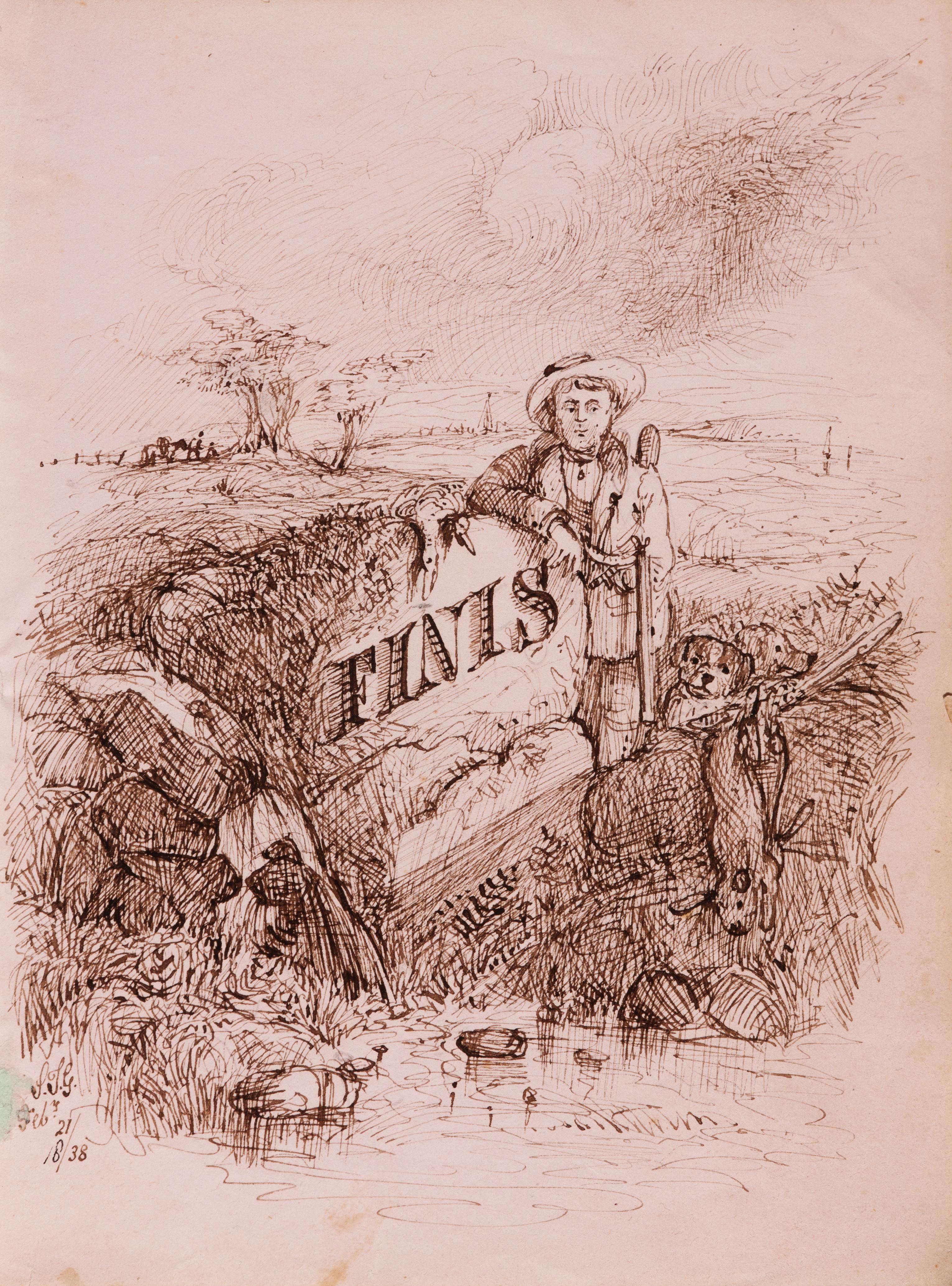 FINIS | Art Gallery of South Australia 659D34
From Gill's "juvenile" sketchbook.
For comment on this and the timing of Gill's migration, see S.T. Gill and Art History's Wrong Turn | The End, Finis, 1838.
The ship Caroline with 45 emigrants had all but completed her long five month voyage as she sailed in Holdfast Bay past South Australia's old beach landing place. She approached the moored light ship Lady Wellington about a mile and a half outside the outer bar of the river. To reach Port Adelaide she would need to pass through a sand-flanked channel. She anchored short of the light ship and awaited the pilot from the beach flagstaff station. Moving again she passed the red beacon buoy and ball that pointed the fair way over the bar; the bar these days being kept clear by the mud barge. Caroline began making her way through the narrow sandy sea reach – barely 150 yards wide at times – on a northeast track, then north, keeping near the starboard bank marked by white beacons where the depth kept her clear of the bottom. Three or four miles then she reached Snapper Point and the hairpin bend atop Le Fevre's Peninsula. She luffed around before her sails caught the breeze to bring her south up the harbour reach. She picked her way between starboard's peninsula mangroves and larboard's Torrens Island sand hills. Mangrove greens, mud browns, smelt and seen.
Caroline passed the new wharf and crane tantalisingly close to completion and the new port town. She anchored mid-stream in sight of the landing place and the road to the city beyond the sand hill. Accompanied on arrival by yet another emigrant ship they joined fifteen other vessels already in port.
It was mid-December 1839.
Parrots and cicadas heard. Flies troublesome. Land at last.4
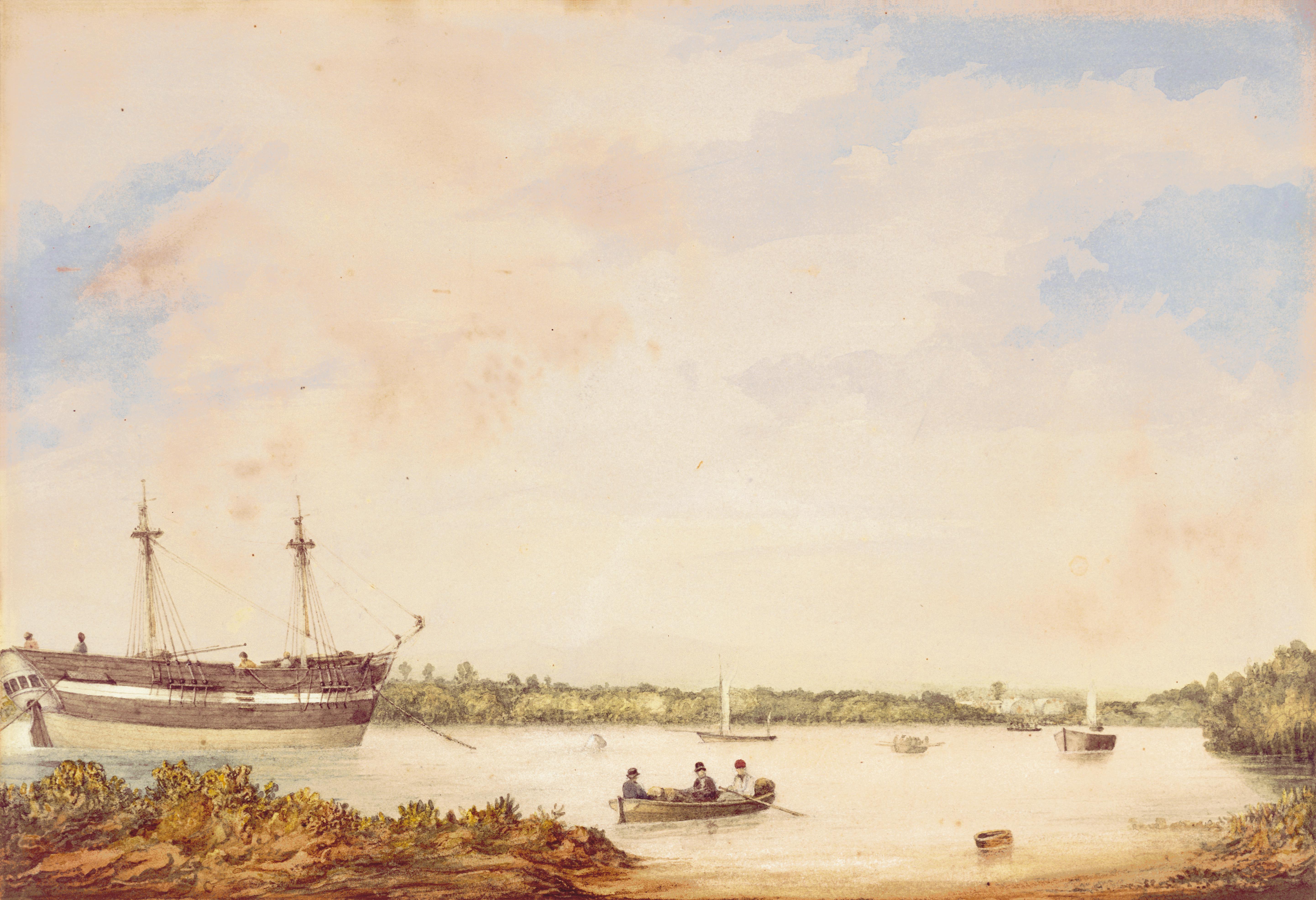 Distant view of the landing place and iron stores at Port Adelaide with the South Australian Company's storeship Sir Charles McCarthy at anchor | Art Gallery of South Australia 0.946
Artist: Light, William | Date: 1838-07~/1839-09~
The brig Sir Charles McCarthy arrived 13 July 1838 from Kangaroo Island, intended as a store ship for Port Adelaide. Colonel William Light painted this watercolour and it was subsequently executed as a lithograph. He died on 6 October 1839, so we can date the scene to a narrow window. The view is south to the "old" landing place.
The Caroline had been five months at sea. Having refreshed at The Cape on 19 October she finally arrived in South Australia on 16 / 17 December. "Mr and Mrs Gill and family"5 were among the 45 emigrants counted by The Government Gazette.6
Samuel Gill brought the means to make a monetary start – a large consignment of general cargo to sell in Adelaide. He would count on his previous experience of running a tea warehouse in Plymouth with a "Mr. Parker from India".1
This December saw a surge of new colonists arriving. In that final week of 1839, the Emigration Office in Adelaide reported 886 newly arrived emigrants from five ships bringing the white population to about 11,000 at the end of the year.
Aboriginal people, of course, had occupied the Adelaide plains for tens of thousands of years.
Caroline started unloading on 23 December. Anchored mid-river, every one and thing was rowed to shore. The South Australian Company's new wharf and crane promised efficiency but they were still under construction.7 (It would later be named McLaren Wharf.) On the plus side, a new stone road into town was mostly finished.
There was advice for new migrants:
On arrival at Port Adelaide you will find plenty of bullock drays and carts waiting there to convey luggage to town; and there is an omnibus every morning and afternoon for the conveyance of passengers, besides which there are gigs and spring carts on hire.8
As well as the Gills' personal belongings there was a great deal of cargo for Samuel Gill to sell in Adelaide. But Christmas beat business and the Gills likely sought out friends new or old at the Baptist chapel in Hindley Street, Adelaide.
Young Sam Gill was 21, his brother John 18, his sister Winifred 15, his father Samuel 46 and mother Winifred (likely) 43.9
Caroline also arrived in time for the annual horse races. 1840 was the third year for the event, held at New Year. As a keen rider10 and lover of horses, it's likely Sam Gill, five months at sea being five months out of the saddle, went to the races. The venue was Adelaide's southeast Park Lands; the Mount Lofty Ranges a blue-green backdrop for the race course dust.
New Year Races 1839 by J.M. Skipper
John Michael Skipper had painted the previous year's events, with the race for "gentlemen riders" featuring a uniformed Captain Charles Berkeley.
1840 was a three day meeting. The first day of racing – 1 January – began with a two heat race over a mile and a half – a three horse sweepstakes for 45 guineas. In the first heat, Mr. Hallack's black gelding Blackthorn made the early running but lost by a head to J. Chambers' black horse Jupiter. Mr Horrocks' chestnut Hohenloe ran third. The second heat was "walked over" by Blackthorn.11
The name Horrocks may be familiar to the reader. There were two Messrs. Horrocks: brothers John Ainsworth Horrocks (1818–1846) and the not so famous Eustace. They had arrived together in South Australia in March 1839. Which one rode Hohenloe? The younger Eustace was sixteen and his physical weakness was likely a factor in him returning to England after just a year in South Australia; so it wasn't he who rode Hohenloe. The other brother, John, was adventurous and twenty-one – the same age as that other recent arrival, Sam Gill. Horrocks had just bought (Young) Hohenloe seven weeks earlier at auction at Captain John Walker's, imported from Circular Head, Van Diemen's Land.12 This was an early test for his new mount.
The second race was for "gentleman riders" not jockeys – two heats of two miles each for a "Ladies' Purse" of twenty-five guineas. The last of the day was a two horse match-race won on forfeit. The second day saw the running of two heats each for two races of two miles. Five horses competed in each. In race two, Hohenloe came a distant last. Three races, including a two horse match-race, were held on the final day. John Horrocks thrice rode Hohenloe in the first two days of the three day event.
If Sam Gill did go to the New Year races, this may be where he first met John Horrocks. Both young men were twenty-one.
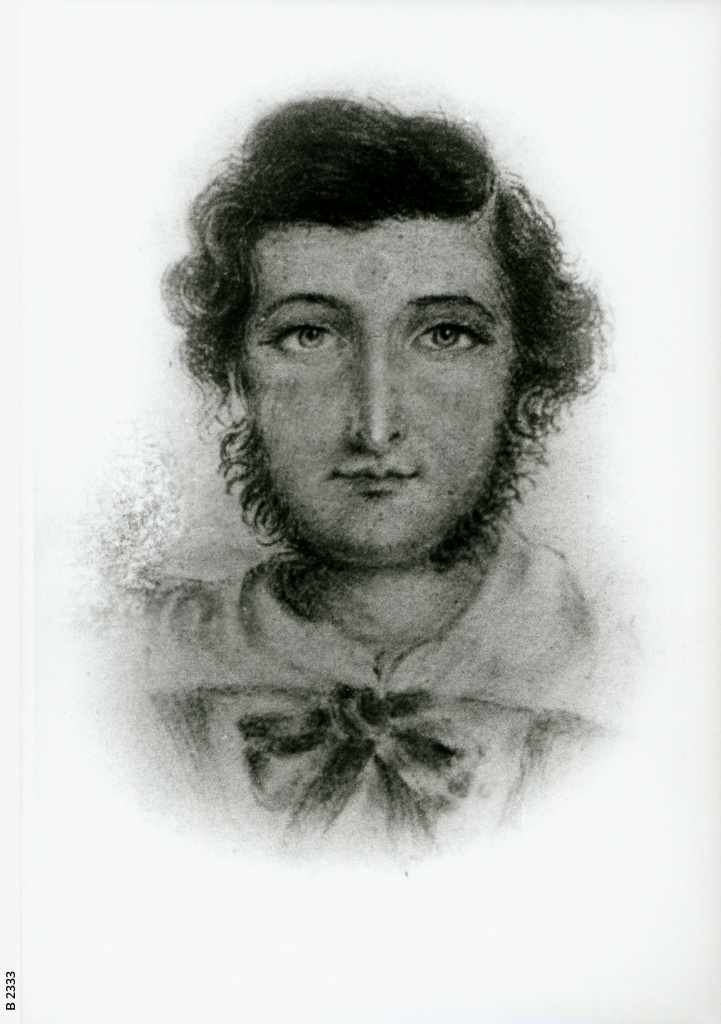
S.T. Gill and the Portraits of J.A. Horrocks
1840. Two portraits of John Ainsworth Horrocks known only by early black and white photographs. I attribute them to Gill and date them to early 1840.
Horrocks would later gain fame for his fatal expedition in 1846, accompanied by Sam Gill as artist. Gill's expedition pictures are among his best.
Sam Gill (21) may have made many lasting connections at the 1840 New Year races just days after arriving in South Australia: John Horrocks (21), John Skipper (24), fellow artist Martha Berkeley (26) and her husband Charles Berkeley (39). In colonial society they were all somebodies; not so Sam Gill, but shared youth and art interest made for connections.
For the Gill family there were more pressing matters than horse races – there was work to do and income to earn.
Samuel Gill senior had bought eighty acres of land. Technically he'd bought a land order – his "country section" was still a promise – its location as yet undetermined, unselected and likely unsurveyed. Finalisation of the process was still months away.
In the meantime he began selling a consignment of cargo from the Caroline with fellow passenger William Salter, operating from Carrington Place.13 Clothing, headwear, footwear, paint pigments, glue, tar, oil, turpentine, cement, a plough, harrows, and three carts. There was "a large assortment of Straw, Dunstable, and Tuscan Hats and Bonnets." A range of paints and pigments: "English umber, Dutch ochre, Venetian Red, Spanish Brown, Powdered Litharge, Lamp Black, Powdered Yellow Ochre, Prepared White Lead, Spanish Brown in powder, White Chalk, fine Whiting."14 Was Sam in the paints department?
Gill looked to make his own contribution to family income, not as a carver and gilder as stated on his migration application, but instead by plying pencil and brush. He likely sought out his own place. There were places to rent, modest enough for a young man. A one-roomed Manning's house (prefabricated in London) was for rent – just 9 feet (2.74m) square with a brick chimney.15 But its location lacked foot traffic. Better located was a "small Manning's" in Gawler Place.16 Did Gill rent it?
S. T. GILL, Artist, &c., late Draftsman and Water Color Painter to the Hubard Profile Gallery of London, begs to announce to his friends and the public generally of Adelaide and its vicinity that he has opened rooms in Gawler-place, where for the present he solicits the attendance of such individuals as are desirous of obtaining correct likenesses of themselves, families or friends. Parties preferring attendances at their residences may be accommodated without additional charge. Correct resemblances of horses, dogs, etc., with local scenery, &c. executed to order. Residences sketched and transferred to paper suited for home conveyance. Orders executed in rotation.
Open daily from eleven till dusk.17
Gill set himself up in the mementoes business – paintings of people, houses, horses and dogs – some to be sent "home" to Britain as signs of emigration success. (His previous employer, London's Hubard Gallery specialised in inexpensive portraiture.18) Correctness emphasised.
Also in Gawler Place was a Wesleyan Methodist Chapel and it became one of his first Adelaide scenes.
Front, Methodist Chapel, Gawler Place | National Library of Australia NK2038/08
Analysis: Wesleyan Methodist Chapel, Gawler Place
This wash drawing likely dates to 1840–1841, making this one of Gill's earliest colonial works – part of his "Series of Adelaide Views".
Having advertised "residences sketched and transferred to paper suited for home conveyance", Gill found an early client in Hindley Street merchant John Walker.
House of Lieut. John Walker R.N. Hindley street Adelaide built 1839 | Mitchell Library, State Library of New South Wales SSV/43
Analysis: John Walker's House and Stores, Hindley Street acres 74 & 75
John Walker's house and stores on Hindley Street (half of acre 75). This was likely painted around the first half of 1840.
So what did happen? And why didn't Sam Gill's career seemingly not take off in 1840?
Gill's announcement in the Register was well located on page one and column one. The first eight lines cost him four shillings; the next eight threepence each – making six shillings in total. Was it money well spent? Gill only ran his advertisement once. Why was this a singular promotion? Did he get so many orders he didn't need to re-advertise?
One reason was the economy. In the same newspaper edition as Gill's advertisement, Robert Thomas' Register took issue (again) with Archibald Macdougall's Southern Australian, over the latter's claim of the Government's insolvency. But the situation with government payments was certainly deteriorating and it wasn't a propitious time to be entering business.
But there may be several explanations for this singular promotion.
The Gill family migration likely had economic and religious justifications, but also family health.20 So when Samuel Gill's daughter, Winifred Mary died on 11 April 1840, aged sixteen,21 the blow had extra punch.
Gill had put up his shingle in March 1840. Competition announced itself as soon as May.
Edward Andrew Opie (c.1809–1879) mounted his own artistic claim in public. From Devon, Opie had arrived in Adelaide in March 1839 and began as a "herald and decorative painter". He was joined in business by J. Kentish "house painter, glazier, paper hanger, &c.". But it was soon the theatre where Opie gained prominence. As early as October 1839, he was noted for theatre painting, scenery and decoration and in November 1839 he had an onstage role at the Royal Victorian Theatre on North Terrace. But his "able" acting career ran second to that for which he deserved much praise – his theatre scenery painting.
Opie's heraldic painting was on show in May 1840 when Opie and Charles Robinson created Queen's Birthday illuminations in Hindley and Rundle Streets, highlighting arms, mottos and themes of nine businesses. Following this shining success, Opie expanded his offering, announcing himself as a portrait painter, art restorer and teacher.
E. A. OPIE, THE SUCCESSFUL CANDIDATE FOR THE ROYAL CORNWALL POLYTECHNIC SOCIETY'S SILVER MEDAL in 1838, BEGS to inform the public in general, that he intends to commence his profession as Portrait Painter, in the City of Adelaide. Orders received at Mr. C. ROBINSON'S, Rundle-street, until a more convenient place can be found. OIL PAINTINGS CLEANED AND REPAIRED. DRAWING TAUGHT.22
Opie soon had favourable press for his "bold and spirited style" in painting three Adelaide views: "A View of the Old Port", "A Bird's-eye View of Adelaide" and "A View of the City from North Terrace." They were commissioned by George Fife Angas back in London and were for lithographing there.
From such efforts of Mr. Opie as have come under our own observation, we think him highly deserving of encouragement; and consider, moreover, that those of the colonists as may wish to send such views to their friends, might advantageously avail themselves of his services.23
Opie had the newspaper attention that Gill would take another five years to win. And in the economic climate any artistic barrow would be an uphill push.
Sameul Gill, senior, pressed on, wholesaling with William Salter at least up to June 1840. The Gill family was eight months in town before Samuel selected his land on 24 August 1840.24 Section 863 – eighty acres in District "B" – was on the upper part of the Sturt River in a valley which become known as Sturt Vale (and later Coromandel Valley).
Map | S. T. Gill - Adelaide District | Gill Section 863
But it was not yet a farm – it was still bush – and those who bought country acres were challenged with time, money and labour to clear the land and till the soil. Only a year earlier, the Register had reflected on those hurdles:
... the first season of our colonial existence had passed away before the surveys were sufficiently advanced to allow possession of the land to be given. Even during the second season, we were in point of fact all but destitute of the means of successfully cultivating the soil. Horses and bullocks, and agricultural implements were scarce and high priced – but had these been cheap, we need scarcely remind our readers that clearing, breaking up, and fencing are not the work of a day ... In point of fact the entire agricultural force in the colony was directed to more profitable and perhaps more requisite employment, namely the transit of goods from the Port to Adelaide, and in the carriage of materials for the erection of buildings ...25
Samuel Gill's acreage was a winding seven or eight miles from Adelaide, first south, then southeast up towards the Government Farms on the upper Sturt River before breaking south again and reaching the Gill property on the banks of the well-watered stream. Father, mother and brothers are likely to have all tackled the clearing, building and home-making, likely helped by their sponsored emigrant labour: house servant Emma Witheridge and house carpenters John Palmer and John Gidley.2
Gill on the Upper Sturt was unremarked except for one small newspaper advertisement:
FOUND, by Messrs Gill, on the river Sturt, section 863, a Dark Bay Timor Pony, having no shoes, a mark on the thigh on the near side ... and a sore back. The owner may have the same by paying the expenses that may be incurred. Apply at the office of this paper. Nov. 16th, 1840.26
The Messrs Gill perhaps referred to the brothers Sam (22) and John (19) working the country section while their father remained in town. (The census seems to confirm this.)
Just days later Samuel senior's wife Winifred died in town at Hanson Street where they retained a residence. Mother and daughter had died within eleven months of arrival in the new colony.
A Government census in early 1841 located the Gills. Census collection began in Adelaide and then extended to the country districts by Easter. Samuel Gill (senior) is recorded alone in Carrington Street, Adelaide. But Sam and his brother John are in District "B" encompassing Gill's section 863. (District "A" immediately surrounded Adelaide; District "B" was next to the south.).27 Along with many, brothers Sam and John Gill had left the depressed town economy to throw their labour at the family's country section.
The Gills had left England's depression for South Australia's booming nascency but throughout 1841 the latter's economy continued to deteriorate. Colonists were deserting Adelaide for the country. Newspaper editor Andrew Murray later reflected on the exodus:
After the disastrous year of 1841, when, chiefly by the dishonor of Government bills and the great reduction of expenditure which followed, bankruptcy became the order of the day, and the colonists were upon the verge of ruin, a great portion of the city population migrated to the country, and the value of town property was exceedingly reduced. Many houses and warehouses became tenantless, and for those which were occupied the rents were trifling and ill-paid. Gradually, also, many of the buildings which were at first very insufficiently constructed became ruinous. At the end of 1842, out of 1,955 houses in North and South Adelaide, 642 were totally deserted, and 216 of the latter were neglected or falling into decay.28
So in these early years, it seems Sam Gill did a lot of farming and any sketching may have been more for himself than clients.
It seems that not long after the census, Gill landed a most prestigious client.
Governor George Gawler had overseen the erection of the then new Government House, completed in late 1839. But he was not resident for long. The news of his recall as Governor arrived along with his replacement, Captain George Grey, on 13 May 1841.
Perhaps Gawler sought a watercolour of Government House as a souvenir of his governorship, or perhaps it was a gift to him on his departure. Either way, it was Gill who painted it. Gawler sailed from South Australia on 25 June 1841.
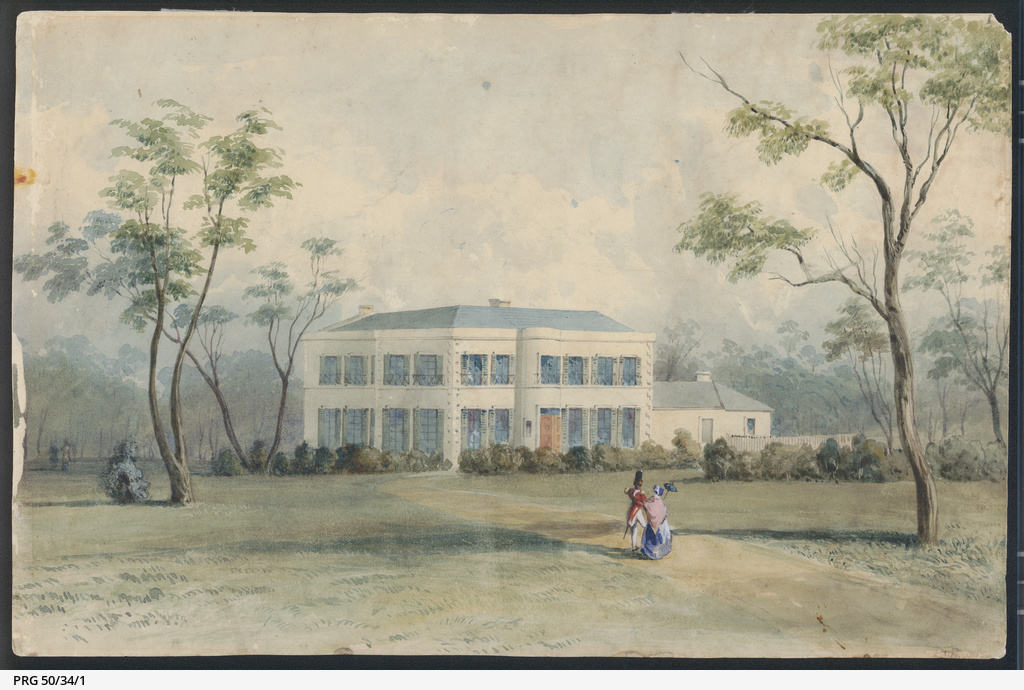
S. T. Gill's Government House for George Gawler | SLSA PRG 50/34/1
Previously attributed to Governor George Gawler, this work is by Gill for Gawler prior to his departure on 25 June 1841. (It is the earliest known picture of "new" Government House.)
This Government House is before Gill developed his typical foreground doodling and busyness of characters. But another had this technique – Frederick Robert Nixon (1817 - 1860), surveyor and amateur artist.
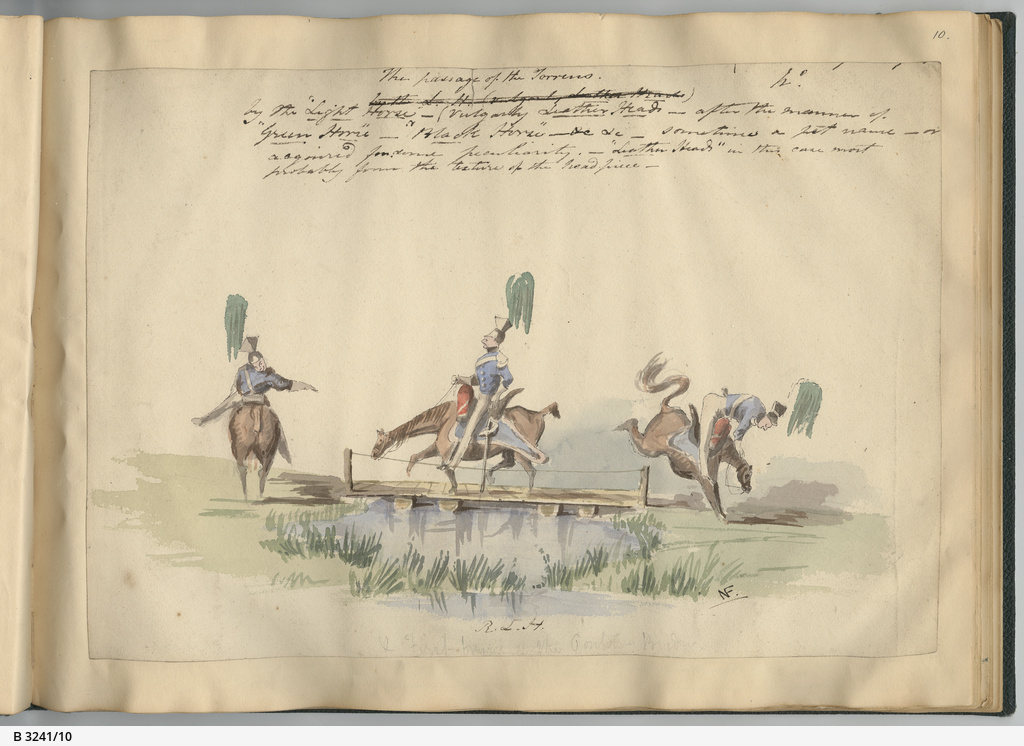 The passage of the Torrens by the "Light Horse" | SLSA B 3241/10
One watercolour of an album of comic sketches of the South Australian militia by F.R. Nixon, March 1840/1841. This work shows Nixon's conspicuous vegetation foregrounding – a technique often used later by S.T. Gill.
Nixon was about seven months older than Gill, and seemingly in some ways further developed as an artist. A close friendship is also hinted at by their Adelaide works being very alike in range and even viewpoint. (For more, see the later F.R. Nixon's Twelve Views, &c., 1845.)
A later impact on Gill's career was James Allen (1806 - 1886). Allen was one constantly on the lookout for opportunity. In July 1841, he launched The South Australian Magazine with himself as editor and Alexander Macdougall as printer. Allen had worked at London's Morning Chronicle and was said to have been a journalistic colleague of Charles Dickens.30 He had arrived in South Australia a couple of months before the Gills and taken up the editorship of Macdougall's Southern Australian. Allen was not averse to taking financial risk in tough conditions. The magazine was the first of his own many publishing ventures. Then in December he launched the South Australian News-Letter.
Allen was also a Baptist minister, as was Samuel Gill, senior.
Although in December 1841 economic activity occupied the populace, E A Opie continued pursuit of "the fine arts".
PAINTING IN SOUTH AUSTRALIA.–The fine arts at present boast of little encouragement in South Australia. The more essential arts of obtaining food and acquiring property as yet occupy, and will for some time engross, even the most cultivated minds among us. When leisure shall exist for the indulgence of taste, we doubt not that Mr. Opie will receive at the hands of his fellow colonists the encouragement he merits. We have just witnessed his last performances, on the walls of the Freemason's Tavern, Pirie-street. They consist of two landscapes and several copies of sculpture. We think they are his most successful efforts in the line.31
The same time in London several of Opie's views were being lithographed.32,33
At the end of the year Harry (Henry) Cooper Jervis joined the "fine arts" push with engravings of Adelaide landmarks.
THE FINE ARTS IN ADELAIDE.
A SERIES of first rate engravings of the principal buildings of Adelaide, by H. Jervis, printed on a sheet of letter paper for the convenience of parties wishing to send
home.
No. 1. Government House, now, ready; proofs 1s. each.
No. 2. Australian Bank, in a few days.
City Engraving & Printing Offices opposite the Royal Oak, Hindley-st.34
 H.C. Jervis Engravings | 1841/1842
H. C. Jervis made engravings in Adelaide of landmark buildings in 1841–1842. Initials "C.W.C" on them became an art history red herring. I think it's more likely Jervis's engravings are based on originals by S. T. Gill. They would thus be Gill's first known works in print. It's noteworthy that Jervis' "Government Offices" is very like views by Gill and Nixon.
James Allen's new organ was an outlet for the writing of F. R. Nixon. A surveyor, Nixon took a ride out of Adelaide perhaps around March or April; his article for James Allen's new South Australian Magazine was ready by the end of May.
Under his nom-de-plume N R F, Fred Nixon wrote about Klemzig in the May-June 1842 edition of James Allen's South Australian Magazine in the first of a series titled "A Ride Through South Australia".35
But to mount our horses ... As travelling in all countries is much improved in its pleasure by having a companion, I am to suppose myself thus provided. Another auxiliary – and not the least either – are a couple of good horses, a week's allowance of the substantial of life, and, in your breast pocket, a small sketch-book. Without these you had better stay at home ...
Nixon toured in company and it's an intriguing possibility that Gill was his companion on this artistic country tour, although there is no direct evidence for this. Following the Torrens River up from Adelaide, Nixon soon reached the German village of Klemzig.
In building the village, the people appear to have previously made a series of plans and sketches, by which their houses should be placed and formed; all is regular, and, at the same time, (though perhaps rather paradoxical,) extremely simple and picturesque. Again, in the dress and looks of the people themselves, there is something certainly much more suited to a picture, or what an artist would select, than anything of the kind we might seek for among our own common-place commercial-looking countrymen.
Analysis of a pencil sketch of the German village of Klemzig. A comparison of the Klemzig pictures of F.R. Nixon, G. F. Angas and S.T. Gill. I re-attribute the sketch from Angas to Gill. Could Sam Gill have sketched the scene on this very ride with Fred Nixon?
In 1842, Samuel Gill, senior, quit Hanson Street, Adelaide, where he'd been keeping a store. Around April to June he managed a property at Goodwood (for Borrow and Goodiar), then in the second half of 1842 he moved to his eighty acre section on the Upper Sturt.36 And it was likely in that year he remarried – to Elizabeth Murray.37
In 1842 the South Australian economy was as flat as a salt lake. Robert Thomas and Co. became insolvent and in August their South Australian Register newspaper and printing business was a forced sale. James Allen bought it cheaply at £600.38 He was a newspaper proprietor for the first of many times. Allen had a newspaper background in London – the Morning Post – and, after his arrival in October 1839 in Adelaide, as editor of the Southern Australian.
Allen also made the Register a city landmark that continues to this day. Soon after his purchase, he built his own premises on the prime location at the north-east corner of Rundle and King William Streets. He moved the newspaper's plant there from Hindley Street. "The pressroom, publishing office, and accountants' room occupied the ground floor, and the upper apartment was used as a caseroom." His brilliantly white two-storey corner building – it was likely built of the local white free-stone – would gleam conspicuously in Sam Gill's paintings. (The location would later become Adelaide's best known meeting point – "Beehive Corner".)
Gill's 1845 sketch of Allen's new building.
E A Opie could well have been one of Gill's greatest professional competitors, but his pursuit of "the fine arts" was ended by a broken arm.
E A Opie initially hoped to establish himself as a portrait painter and saw early success as a landscape painter. But despite his work being well received, it was not enough financially. Most of Opie's work was heraldic and decorative, interiors and signs, and he was also relying on his theatre work for both income and enjoyment. After initial success at Adelaide's Queen's Theatre in 1841, attendances and performances dropped, and Opie sought to renew his acting and set painting elsewhere. He left for Launceston in September 1842.40 His departure from South Australia meant a little less competition for Gill.
About this time payable copper was found in South Australia. Captain Bagot and Francis Dutton agreed to exploit it together, purchased an eighty acre section and, importantly, kept it quiet.41
The army moved barracks at the end of 1842: from Grenfell Street to new barracks in Flinders Street. Gill painted the former barracks around this time, probably for the newly promoted Lieutenant John Napier Magill.
Gill found a ready clientele in army officers posted to South Australia.
Meanwhile in Sydney, New South Wales, a new technology arrived and would become in time a grand disrupter – the Daguerreotype. It was imported from London in November 1842 by George Goodman, Australia's first commercial photographer.
Goodman was a master of advertising, and knew the value of editorial, especially when supplying the majority of the print matter himself. Unsurprisingly Goodman obtained a glowing report in The Sydney Morning Herald from a pre-opening demonstration.
DAGUERREOTYPE.–Yesterday, Mr. Goodman opened, for the first time to the public, his gallery for taking portraits according to the invention which has recently created such an extraordinary sensation in England and France ... We have seen many of the portraits which issued from the laboratory during the week before it was opened to the public ... The likenesses are indeed exact, and the sitter is only kept in suspense about half a minute; after which a very few minutes suffice to the polishing up and framing the minature. Mr. Goodman has completed some sixty or seventy of these minatures since his apparatus has been in order at the Royal Hotel ... The charge is extremely moderate–a portrait, frame, and case, being less than the cost of a new hat, or a box at the theatre.42
Photography invaded the territory occupied by portrait painters. But it would be another three years before this impact was felt in South Australia.
Did Gill think about shifting his focus away from "individuals ... desirous of obtaining correct likenesses of themselves, families or friends"? Did he choose to turn away from subjects inside and under-cover and towards scenic outdoors?
Meanwhile the economy was improving. From 1841 to 1842 South Australian sheep numbers nearly doubled from 242,000 to 460,000. Wool exports were likewise growing.43
In January 1843 Samuel Gill, senior, took out an occupation licence44 (allowing him to build, reside and depasture stock) – very likely running sheep.
Gill junior largely reflected this primary economy.
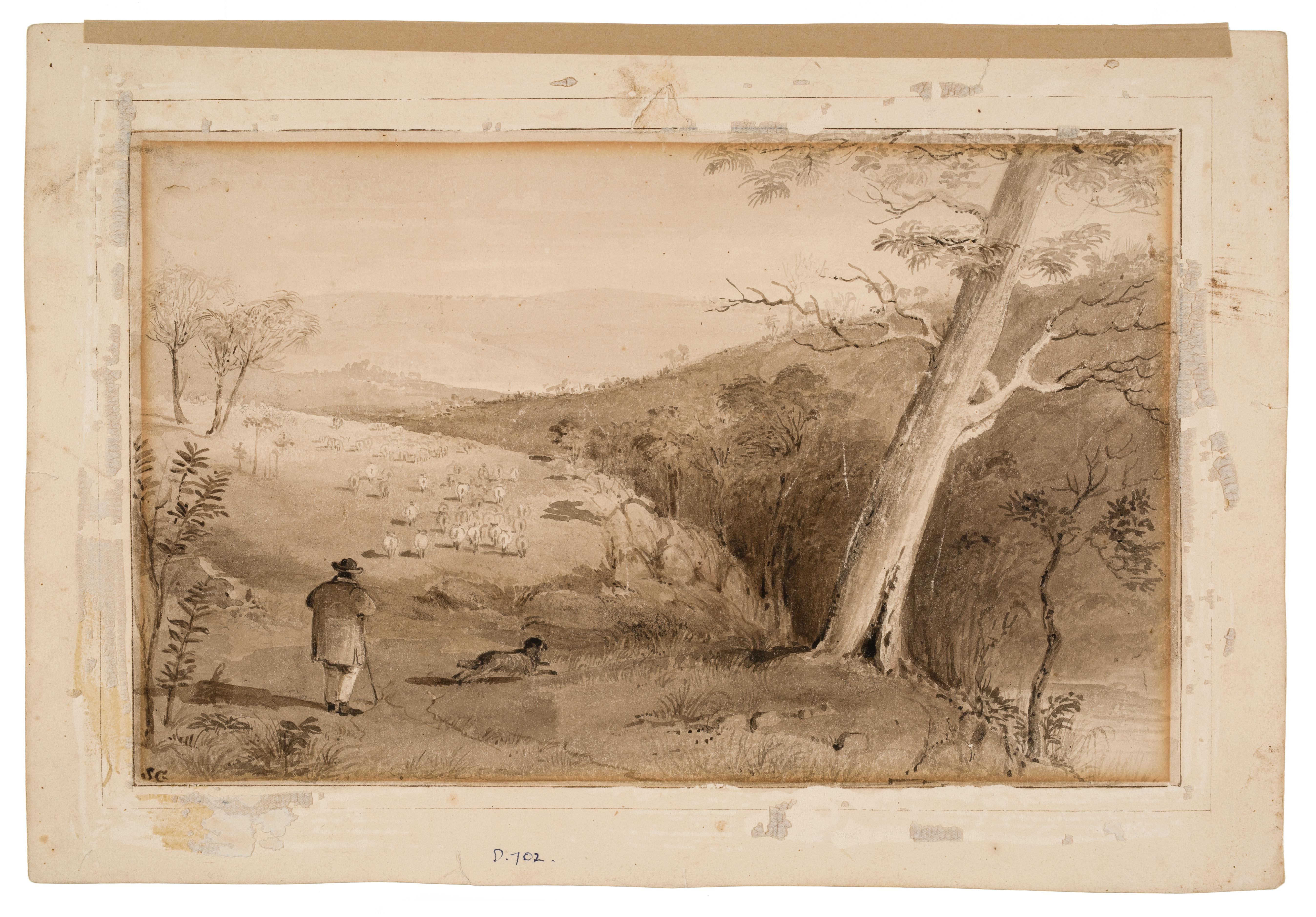 Shepherd and dog with sheep | AGSA 625D1
Left: A shepherd and his dog minding a flock on the side of a hill.
This appears to be one of the earliest South Australian works by Gill.
The economy was seeing more movement, especially with wool, but now there was copper just under the surface. With mineral riches, the economy would take off.
Narrative (continued), 1843 to 1844 →
Chart of Port Adelaide, South Australia, 1839-1840. By F. H. Burslem. SLSA BRG 42/120/3 <https://collections.slsa.sa.gov.au/resource/BRG+42/120/3>
Cummings, Diane, 2010-2017 and State Library of South Australia. South Australian Passenger Lists <https://bound-for-south-australia.collections.slsa.sa.gov.au> and <https://bound-for-south-australia.collections.slsa.sa.gov.au/1839Caroline.htm>. Accessed 8 January 2025.
David Coombe, original 26 November 2025, updated 6 May 2026. | text copyright (except where indicated)
CITE THIS: David Coombe, 2025, S.T. Gill - An Early Narrative, 1839 to 1842, accessed dd mmm yyyy, <https://coombe.id.au/S_T_Gill/S_T_Gill_Early_Narrative_1839_to_1842.htm>